
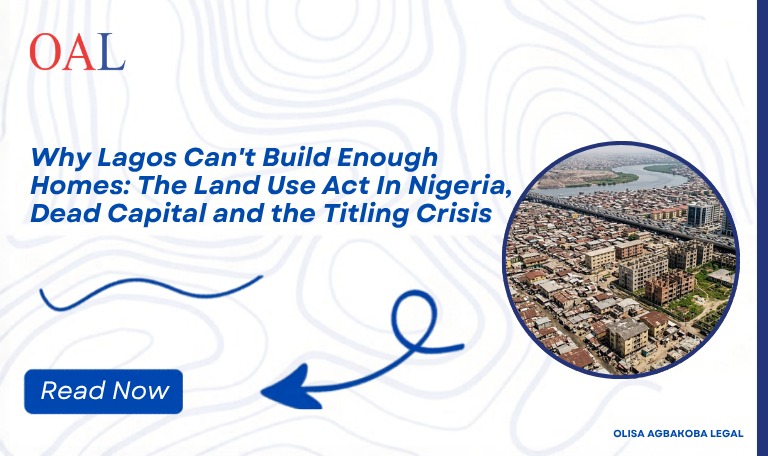
The Land Use Act in Nigeria has shaped land ownership for decades, but it has also become one of the biggest obstacles to solving Lagos’ housing crisis. A family in Ikoyi spent seven years in court proving they owned their own land – a 1,200 square metre property worth roughly ₦5 billion. They had lived on it, paid for it, built on it. But without a perfected title, ownership in Lagos is an argument, not a fact. Dr. Kemi Onanuga, Partner and Head of Real Estate at OAL, told their story at the “Ease of Doing Real Estate in Lagos” forum in Ikoyi to make a point that frames the whole housing debate: Lagos needs an estimated 3.4 million homes, and the biggest obstacle is not land, money or demand, it is the law. From the Land Use Act’s consent regime to a titling system that leaves fewer than 5% of Nigerian land formally documented, the legal architecture itself is holding the market back. This piece unpacks how, and what would have to change.
The forum, titled “Ease of Doing Real Estate in Lagos,” was co-hosted by OAL, Penuel Prime, and the Diaspora Heritage Foundation at the Wheatbaker Hotel. It brought together key figures such as the Lagos State Commissioner for Housing, Hon. Moruf Akinderu-Fatai, alongside a diverse group of lawyers, developers, financiers, and diaspora investors. Notable attendees included Mr. Ayodeji Fashanu, Mr. Dayo Shola, Barrister Osahon Idemudia, Mrs. Ify Akerele, Alhaji Abubakar Sheriff, and many others. Commissioner Akinderu-Fatai shared encouraging news of upcoming reforms, which we have elaborated on in detail in our blog titled: “Lagos Tenancy Bill 2025 and Lagos Property Reforms 2026: What Landlords, Tenants, Agents, and Developers need to know”.
This piece delves deeper into the more challenging aspect of the crisis: the structural and primarily legal issues that prevent Lagos from housing its citizens effectively and what must change to remedy this situation.
Lagos Housing Deficit: The Numbers Behind the 3.4 Million Home Shortage
This insightful diagnosis revealed unsettling statistics for anyone viewing Lagos real estate solely through a lens of growth. The current housing deficit stands at approximately 3.4 million units, a 15% increase over the past decade. Over 60% of residents reside in informal or substandard housing. Alarmingly, fewer than 5% of new housing units are priced below ₦15 million in a city where a significant number of workers earn less than ₦100,000 a month. As Dr. Onanuga put it, we face a structural market failure devoid of a self-correcting mechanism. During her opening remarks, she emphasised that the housing crisis transcends mere economics; it is fundamentally a governance issue. While the government has indeed expanded social housing, she sharply questioned whether it is genuinely affordable for the average Lagosian. The industry must find ways to accommodate both the affluent and those in need.
The Land Use Act 1978: Why Governor’s Consent Makes Land So Hard to Title in Nigeria
Almost every barrier mentioned at the forum traces back to one piece of legislation: the Land Use Act of 1978. Section 1 of this Act vests all land in each state under the Governor’s authority, with the intention of facilitating democratic access to land. However, nearly five decades later, it has established a centralised consent regime. Under Sections 21 and 22, virtually no assignment, mortgage, or transfer of land interest is valid without the requisite consent – the Governor’s for statutory rights, and in some cases the Local Government’s for customary rights. This single requirement has evolved into one of the most expensive bottlenecks in Nigerian commerce. Industry estimates highlighted in the forum indicate that fewer than 5% of land parcels in Nigeria are formally titled, and the associated costs, like consent fees, stamp duties, and survey charges, can inflate overall housing development costs by 15 to 20%.
A crucial legal nuance often overlooked is that the Land Use Act is entrenched in the Constitution under Section 315(5) of the 1999 Constitution. This means it cannot be amended like ordinary legislation; it requires a constitutional amendment, a complex and challenging process. Consequently, every administration promises land reform, yet none deliver it. This problematic law is, paradoxically, the hardest to amend.
Untitled land, as Hernando de Soto famously described, becomes “dead capital.” Both Dr. Onanuga and the Commissioner cited this concept, stressing that such land cannot be mortgaged, insured, or developed formally. Landholders are left only with the hopes of eventual ownership. The discussion pointed to successful examples like Rwanda’s national titling program and digital land reforms in Kaduna and Kano, showing that mass titling is achievable with political will. While Lagos’s E-GIS initiative shows promise, the backlog remains significant.
Mortgage Rates, Informal Workers and Nigeria’s Housing Finance Gap
If title issues are the first barrier, financing poses the second, and both issues are interlinked. Nigeria’s mortgage-to-GDP ratio lingers below 1%, one of the lowest in Africa, while countries like South Africa boast ratios between 20% and 30%. Commercial mortgage rates fluctuate between 15% and 28% per annum, rendering mortgages inaccessible for many and categorising them as luxury products.
The fundamental problem is structural. According to the NBS Labour Force Survey, a staggering 92.2% of employed Nigerians work in the informal sector—traders, artisans, transport workers—who lack payslips or formal documentation. Traditional credit assessments often overlook these individuals. Lagos itself has an estimated 4.6 million informal workers. The housing finance system, built on the premise of formal employment, essentially excludes the majority of the city’s population. Meanwhile, alternative credit models based on mobile money and savings group histories successfully operate in other emerging markets, pointing to potential avenues for change in Lagos.
The Boldest Idea in the Room: Land as Equity, Not Compensation
During the forum, Barrister Osahon Idemudia, Managing Partner of Iroghama LP, sparked a captivating conversation that challenged the status quo. He boldly asserted that real estate is a store of value, so why is it financed like a corner shop? Idemudia proposed innovative tradable real estate notes, which are asset-backed instruments that would allow everyday investors to engage in property development. This approach could inject much-needed liquidity into a market that currently lacks it.
His second proposal was even more groundbreaking. Currently, when communities lose land for significant projects, the Land Use Act’s compensation framework (Section 29) offers them a one-time payment. This leaves them sidelined while their land generates wealth for decades. Idemudia’s alternative? Allow communities to contribute land as equity, enabling them to retain a stake in the developments that arise from it. This initiative could transform the narrative from being bought out of an inheritance to becoming a shareholder in it. Implementing such a change would necessitate a reform of the very Act entrenched in the Constitution, raising important questions about governance.
Titles, Approvals, Finance: Why Lagos Must Fix All Three at Once
The heart of the forum revolved around the insights presented in Dr. Onanuga’s paper: land titling, regulatory efficiency, and housing finance are interdependent. Without bankable titles, the poor remain excluded from access to finance. Fast approvals do little without financial backing, and affordable financing has no projects to support without secure titles. Reforming just one pillar may grab headlines, but transforming all three is essential to addressing the housing crisis.
This is why the discussion was pivotal. Key stakeholders, government officials, legal experts, developers, and financiers, gathered in one room to agree on a shared diagnosis of the situation. The pressing question remains: will this insightful diagnosis lead to successful implementation?
Moreover, we must acknowledge the urgency of the situation: while policy debates unfold, individual property owners cannot afford to hesitate. The Ikoyi family’s seven-year battle for their property concluded successfully because they fought for their documentation. Unfortunately, thousands of land disputes across Lagos end with demolished structures, double sales, and lost capital.
Whether you are looking to perfect a title, structure a development, resolve a land dispute, or plan a diaspora investment in Lagos property, OAL’s Real Estate team blends transactional expertise with the policy insight gained from discussions like the one held last Friday. The forum’s message was clear: the importance of proper documentation cannot be overstated. We encourage you to reach out to us today to ensure your property interests are secure.
Frequently Asked Questions
- What is the housing deficit in Lagos?
An estimated 3.4 million units are needed as of 2025, reflecting a 15% increase over the past decade, with over 60% of residents living in informal or inadequate housing.
- Why is Governor’s consent required for land transactions in Nigeria?
Sections 21 and 22 of the Land Use Act 1978 mandate the Governor’s consent for nearly all land interest transfers because Section 1 vests all land in the State Governor in trust for the people.
- Can the Land Use Act be amended?
Amending the Act is a challenging process, as it is entrenched in the Constitution under Section 315(5), effectively requiring a constitutional amendment.
- Why is mortgage penetration so low in Nigeria?
Mortgage penetration is below 1% of GDP, driven by interest rates ranging from 15% to 28%, weak land titling –where less than 5% of parcels are formally titled – and a credit system that does not cater to the 92% of workers employed in the informal economy.