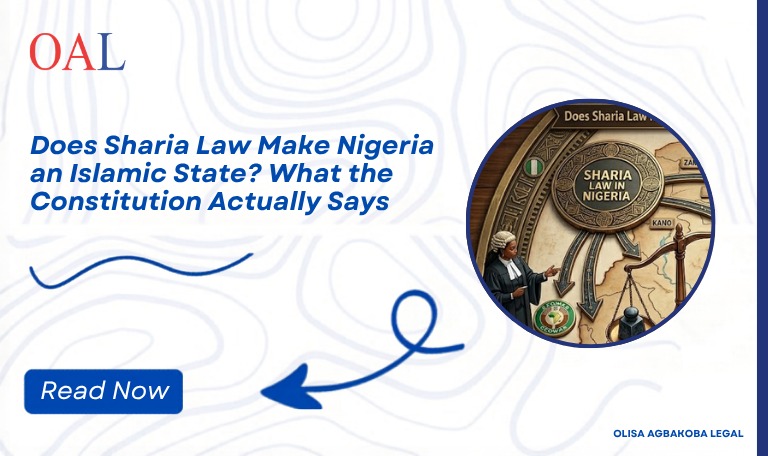
Few words spark as much anxiety in Nigeria as Sharia Law in Nigeria. And for many Nigerians, especially non-Muslims, this term evokes a quiet fear: that its growing application is a gradual step toward establishing an Islamic state, where one faith governs all
This concern deserves serious attention, yet it also warrants a thoughtful examination. When you set emotion aside and look at the legal framework, a more reassuring and far more interesting picture emerges.
The Return of Sharia Law in Northern Nigeria
Sharia is not a new concept in the North. For centuries, Islamic law governed marriage, inheritance, and family matters in the region, predating colonial rule. Under the British colonial rule, Sharia was largely restricted to personal and civil issues, with a uniform Penal Code imposed in 1959. The modern era of Sharia began in 1999. As Nigeria transitioned back to democracy, Zamfara State, led by Governor Ahmad Sani Yerima, passed a Sharia Establishment Law that extended Sharia into criminal law for Muslims. This law took effect on January 27, 2000, creating an immediate political ripple. By 2002, twelve states in Northern Nigeria had adopted various forms of Sharia criminal law: Zamfara, Kano, Sokoto, Katsina, Kebbi, Yobe, Bauchi, Borno, Gombe, Niger, Kaduna, and Jigawa. Many of these states established Hisbah boards to promote compliance with Islamic moral codes. Supporters viewed this as a return to discipline and justice in a region plagued by poverty and corruption, while critics warned of a potential clash with Nigeria’s secular foundation.
What the Constitution Actually Says
The 1999 Constitution is clear about Nigeria’s religious identity. Section 10 of the Constitution of the Federal Republic of Nigeria, states unequivocally: “The Government of the Federation or of a State shall not adopt any religion as State Religion.” This single line serves as a firewall, establishing Nigeria as a multi-religious state where no government, federal or state, can elevate one faith above others. Section 38 of the Nigerian Constitution (under Chapter IV on Fundamental Rights) reinforces this by guaranteeing every Nigerian the right to freedom of thought, conscience, and religion, including the freedom to hold beliefs, change them, and practice them openly. Moreover, Section 1(3) asserts that the Constitution is supreme: any law conflicting with it is void to the extent of that conflict.
Many misunderstand Sharia’s role in Nigeria. The Constitution acknowledges the existence of Sharia courts, but it is important to note what these courts can actually handle. Under Sections 275 and 277, a State Sharia Court of Appeal only deals with Islamic personal law, which includes marriage, divorce, family relationships, guardianship, gifts, wills, and inheritance, and crucially, only when all parties involved are Muslim. In essence, the Sharia law recognised by Nigeria’s Constitution mainly serves as a system of family and civil law for those who choose to abide by it. It is one of three legal traditions woven into the Nigerian system, alongside English common law and customary law.
Sharia Applies to Muslims, And Not to Everyone
Here is the crucial point that often gets lost in the discussion: even in the twelve states that have adopted Sharia criminal codes, these laws apply solely to Muslims. A Christian, traditionalist, or any non-Muslim residing in Kano or Sokoto is not tried under Sharia for criminal offenses. They remain under the secular Penal Code and continue to have full access to regular courts. Therefore, a state adopting Sharia does not subject every citizen to Islamic law. Kano is not becoming a mirror image of Tehran. A non-Muslim in a Sharia state retains their constitutional rights, their own faith, and their own courts. This does not create an Islamic state; it is a federation accommodating the diverse religious choices of its people within constitutional boundaries.
The Cases That Tested, and Proved the Nigeria Constitution Prevailed
Theory is one aspect; practical implications tell another story. Two high-profile cases illustrate how Sharia’s harshest penalties interact with Nigeria’s constitutional reality. In October 2001, Safiya Hussaini was sentenced to death by stoning by a Sharia court in Sokoto after giving birth outside of marriage. This verdict triggered global outrage. Upon appeal in March 2002, she was acquitted. Shortly afterward, in March 2002, Amina Lawal faced similar charges in Katsina and was sentenced to death by stoning. Her case received international attention, and on September 25, 2003, the Katsina State Sharia Court of Appeal overturned her conviction, citing significant procedural errors, namely, that only one judge had presided over her initial trial instead of the required three. Neither sentence was executed, thanks to the intervention of the system’s appeal courts and Nigeria’s constitutional safeguards. The harshest interpretations of Sharia were unable to withstand scrutiny. The Constitution prevailed.
Is Nigeria Becoming an Islamic State?
Legally speaking, the answer is no. Nigeria is, by constitution, a secular and multi-religious republic. No state has the authority to declare an official religion, and religious freedom is a fundamental right protected by law. The Nigerian Constitution is the supreme legal document, taking precedence over state laws, Sharia codes, and the actions of governors. Furthermore, all courts, including Sharia appeal courts, function within this legal hierarchy.
Scholars continue to debate whether criminal Sharia law aligns with Sections 10 and 38 of the Constitution. Minority communities, women’s rights advocates, and observers of blasphemy cases express serious concerns that warrant thoughtful discussion rather than dismissal. A mature democracy thrives on these open conversations.
It is essential to distinguish between “some states apply Sharia to their Muslim citizens” and the more alarming notion that “Nigeria is turning into an Islamic nation.” Such a leap in reasoning lacks legal support and overlooks the safeguards the Constitution provides.
Nigeria’s strength, and its challenge, lies in its diversity. We are a nation of various faiths united under one supreme law. Sharia is part of this intricate mosaic, not a threat, as long as the Constitution remains authoritative and is enforced impartially. A right enshrined on paper means little without the commitment to uphold it. The true protection of religious freedom in Nigeria hinges not on silence or suspicion, but on an informed public and an independent judiciary that ensures every law, including Sharia, answers to the Constitution.
OAL works at the intersection of law, legal advisory, policy, governance and public interest in Nigeria. We believe the rule of law is strongest when citizens understand it.