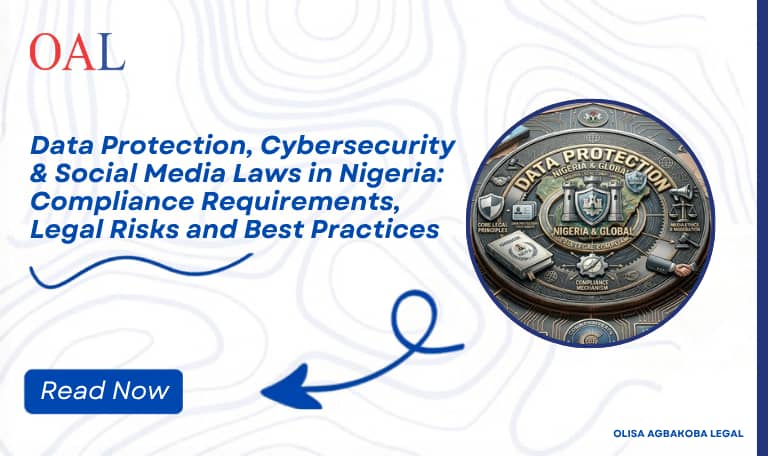
Data Protection, Cybersecurity & Social Media Laws in Nigeria have become critical areas of compliance as organisations rely more heavily on digital technologies, online platforms, and data-driven operations. From multinational corporations and financial institutions to SMEs, startups, influencers, and non-profit organisations, every entity that collects personal data, conducts business online, or engages audiences through social media faces growing legal and regulatory obligations.
The enactment of the Nigeria Data Protection Act (NDPA) 2023, increased enforcement by the Nigerian Data Protection Commission (NDPC), and rising concerns about cybercrime, online defamation, and data privacy have transformed the country’s regulatory landscape. A single data breach, cybersecurity incident, or unlawful social media publication can expose organisations to regulatory penalties, litigation, financial losses, and reputational damage.
Recent enforcement actions against Meta, Fidelity Bank, and MultiChoice Nigeria demonstrate that regulators are increasingly willing to hold organisations accountable for privacy and cybersecurity failures. As Nigeria’s digital economy continues to expand, businesses can no longer afford to treat compliance as a secondary concern.
This guide examines the key data protection, cybersecurity, and social media laws in Nigeria, highlighting the compliance requirements, legal risks, and best practices that organisations and individuals should understand to operate safely and lawfully in the digital age.
Nigeria’s Digital Regulators Are No Longer Waiting
For many years, digital compliance was viewed as a future concern. Businesses prioritised growth, innovation, and digital transformation while privacy and cybersecurity issues were often left to IT departments. That approach is becoming increasingly difficult to justify.
In 2024, Nigeria’s Federal Competition and Consumer Protection Commission (FCCPC) imposed a $220 million penalty on Meta following an investigation into alleged consumer protection and data privacy violations affecting Nigerian users. The Competition and Consumer Protection Tribunal later upheld the decision, reinforcing the growing willingness of Nigerian regulators to take action against organisations that fail to comply with applicable laws. The significance of the case extends beyond global technology companies.
Whether you operate a fintech startup, a healthcare facility, a law firm, an educational institution, an e-commerce platform, or a personal brand on social media, regulators increasingly expect organisations to demonstrate accountability in the way they collect, process, store, and protect personal information.
At the same time, cyberattacks continue to evolve, while social media has amplified the speed at which legal and reputational crises can develop. A compliance failure today can become a regulatory investigation tomorrow.
The Three Laws Every Nigerian Business Should Understand
1. The Nigeria Data Protection Act 2023
The Nigeria Data Protection Act (NDPA) 2023 is the foundation of Nigeria’s data privacy framework. The Act regulates how organisations collect, process, store, transfer, and protect personal data.
Importantly, the Act is not limited to technology companies. Any organisation that processes personal information, including banks, schools, hospitals, telecommunications providers, professional service firms, NGOs, and startups, may fall within its scope.
The NDPA is built around principles such as lawfulness, transparency, accountability, data minimisation, and security. In practical terms, organisations must have a legitimate basis for collecting personal data and must take reasonable steps to protect it throughout its lifecycle.
Recent enforcement actions demonstrate that data protection compliance is no longer theoretical.
In 2024, the NDPC sanctioned Fidelity Bank following an investigation into alleged data protection violations involving customer onboarding processes and informed consent. In 2025, the Commission imposed a ₦766.2 million penalty on MultiChoice Nigeria following an investigation into alleged privacy rights violations and concerns relating to cross-border transfers of personal data.
These developments reflect a broader regulatory trend. Data protection compliance is no longer merely a best practice. It is becoming a business necessity.
2. The Cybercrimes Act
While the NDPA focuses on personal data, the Cybercrimes (Prohibition, Prevention, etc.) Act, 2015, addresses cyber-related offences and the protection of digital infrastructure.
The Act criminalises activities such as:
- Unauthorised access to computer systems.
- Identity theft.
- Phishing schemes.
- Electronic fraud.
- Cyberstalking.
- Online impersonation.
For many organisations, the greatest risk is not simply becoming a victim of cybercrime. The greater risk may be failing to demonstrate that reasonable safeguards were in place before an incident occurred.
A successful cyberattack can expose sensitive information, disrupt operations, trigger investigations, and damage customer confidence. What begins as a technical problem can quickly become a legal and commercial crisis.
This is why cybersecurity is increasingly viewed as a boardroom issue rather than merely an IT concern. For a deeper analysis of cyber legal risks, see OAL’s article on ransomware and cybersecurity compliance in Nigeria.
3. Social Media and Online Publication Risks
Social media has become one of the most powerful business and communication tools available today. It has also become one of the most significant sources of legal risk.
Many people mistakenly assume that social media operates outside traditional legal principles. It does not.
The same legal rules that apply to newspapers, television broadcasts, and formal publications may also apply to content shared on Facebook, Instagram, LinkedIn, TikTok, WhatsApp, YouTube, and X.
One of the most common risks is defamation. A person or organisation may face liability where false statements published online damage another person’s reputation. The fact that a statement appears in a tweet, video, comment, or WhatsApp message does not reduce the legal consequences that may follow.
Similarly, the Cybercrimes Act criminalises certain forms of cyberstalking and online harassment. Conduct that many people dismiss as “social media drama” can, in some circumstances, attract civil or criminal liability.
Influencers and content creators should also exercise caution. As influencer marketing grows in Nigeria, so too do the risks associated with misleading promotions, false claims, privacy violations, and unauthorised use of intellectual property.
Key Legal Risks Under Nigeria’s Digital Regulatory Framework
Data protection, cybersecurity, and social media governance are often treated as separate issues. In reality, they are increasingly interconnected.
The most significant legal risks include:
- Regulatory Penalties : Regulators are becoming more active in enforcing compliance obligations. Recent actions involving Meta, Fidelity Bank, and MultiChoice Nigeria demonstrate that organisations may face substantial regulatory penalties where violations are identified.
- Data Breaches : A data breach can expose an organisation to investigations, customer complaints, compensation claims, and operational disruption. Beyond the immediate financial cost, organisations often face long-term reputational consequences. OAL’s article on data protection audits outlines the practical steps organisations can take to reduce this risk.
- Cybercrime Exposure : Businesses that fail to implement appropriate cybersecurity safeguards may become vulnerable to phishing attacks, ransomware incidents, fraud, and unauthorised access to confidential information. See OAL’s analysis of cybersecurity legal obligations for a detailed breakdown of regulatory duties.
- Defamation and Social Media Liability : A single social media post can trigger legal action if it contains false statements that damage another person’s reputation or violate another legal right. The legal risk associated with social media liability today can be greater than the legal risk of a newspaper article twenty years ago.
- Reputational Damage : Trust remains one of the most valuable assets any organisation possesses. A cybersecurity incident, privacy violation, or social media controversy can spread rapidly online and negatively affect customer confidence, investor relationships, and business opportunities. The resulting reputational damage can persist long after any regulatory process has concluded.
Why Data Protection, Cybersecurity and Social Media Laws in Nigeria Matter for Businesses
Many organisations continue to approach digital compliance in silos. Privacy issues are handled by compliance teams. Cybersecurity is delegated to IT departments. Social media management is assigned to marketing teams.
That approach is becoming increasingly outdated. Consider a common scenario. An employee clicks a phishing link. A cybercriminal gains access to customer information. Personal data is exposed. Customers begin complaining publicly on social media. Regulators launch a regulatory investigation. Media coverage follows.
What began as a cybersecurity incident has become a data protection issue, a regulatory issue; digital compliance is no longer about individual laws. It is about managing interconnected risks across the organisation.
What Organisations Should Do Now
The good news is that most compliance failures are preventable. Five practical steps can significantly reduce risk.
First, review your data collection practices. Understand what personal information is collected, why it is collected, where it is stored, and who has access to it.
Second, update privacy policies and notices. Many organisations continue to rely on outdated privacy notices that do not accurately reflect their practices.
Third, invest in employee training. Human error remains one of the leading causes of cybersecurity incidents and data breaches.
Fourth, develop incident response procedures. Organisations should know how they will respond before an incident occurs, not after.
Finally, review social media governance. Employees, executives, and brand representatives should understand the legal and reputational consequences that may arise from online publications.
A New Era of Digital Compliance in Nigeria
For years, many organisations treated privacy, cybersecurity, and social media governance as separate concerns. That approach is becoming increasingly difficult to sustain.
Regulatory enforcement is increasing. Cyber threats are becoming more sophisticated. Reputational crises now unfold in real time across digital platforms. At the same time, customers, regulators, and business partners expect organisations to demonstrate greater accountability in how they manage information and digital risks.
Organisations that fail to adapt may face legal, financial, and operational consequences. Those that invest in compliance, however, are likely to be better positioned to earn public trust, manage risk effectively, and compete successfully in an increasingly digital economy.
Frequently Asked Questions
Can a Nigerian company be fined for a data breach?
Yes. Depending on the circumstances, a data breach may trigger investigations and regulatory action under applicable laws, including the Nigeria Data Protection Act 2023.
Can someone be sued for a social media post in Nigeria?
Yes. Social media posts may give rise to claims involving defamation, privacy violations, cyberstalking, harassment, or other legal causes of action, depending on the facts of the case.
Does the NDPA apply to small businesses?
Potentially. The size of a business does not automatically determine whether the Act applies. Any organisation that processes personal data relating to individuals in Nigeria should assess its obligations under the NDPA. OAL’s article on data protection compliance for organisations provides further guidance.
Navigating Data Protection, Cybersecurity and Social Media Laws in Nigeria
Navigating Data Protection, Cybersecurity, and Social Media Laws in Nigeria is no longer optional for organisations operating in today’s digital economy.
The $220 million penalty imposed on Meta was not merely a dispute between a regulator and a technology company. It was a signal that Nigeria’s digital regulatory landscape has entered a new phase.
The Nigeria Data Protection Act 2023, the Cybercrimes (Prohibition, Prevention, etc.) Act, and the legal principles governing online publications collectively create a framework that businesses and individuals can no longer afford to ignore.
Organisations that continue to treat data protection, cybersecurity, and social media governance as secondary concerns may find themselves facing investigations, litigation, financial losses, and reputational damage.
Those that invest in compliance today will be better positioned to build trust, manage risk, and compete successfully in an increasingly digital economy.
As regulators become more active and cyber threats continue to evolve, one thing is clear: data protection, cybersecurity, and social media compliance have become essential components of modern business governance in Nigeria. Olisa Agbakoba Legal (OAL) advises organisations across sectors on navigating Nigeria’s evolving digital regulatory framework.