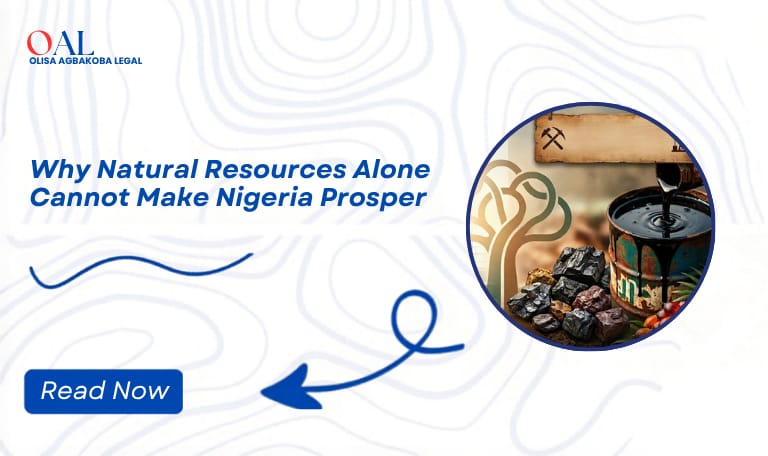
A nation’s wealth is not defined by what lies beneath its soil, but by what its leaders choose to do with what they have. There is a governance idea often attributed to former British Prime Minister Margaret Thatcher that captures this reality with striking clarity: “Countries are not rich because of what sits under their soil. They are rich because of the policies their leaders choose to pursue.”
This is not a statement about natural resources or geology. It is a governance statement. It argues that prosperity is shaped less by natural endowment and more by policy discipline, institutional strength, and consistency in leadership decisions.
Thatcher reinforced this thinking with another widely cited principle: “Man’s greatest resource is man himself.” The implication is simple: a nation’s real wealth lies in its people, and in the systems that either enable or limit their ability to thrive.
This lens becomes especially important when applied to Nigeria. Nigeria is richly endowed with oil and gas reserves, vast agricultural land, solid minerals, and a large, youthful population that should represent a major developmental advantage. Yet despite these endowments, Nigeria continues to struggle with persistent poverty, weak infrastructure, and underperforming institutions.
If resources are not the problem, then what is? Increasingly, the answer points to governance choices rather than resource scarcity.
Nigeria’s Development Paradox
Nigeria represents one of the clearest examples of a resource-rich nation struggling with development outcomes. Nigeria should be an economic powerhouse. It has one of the largest oil and gas reserves in Africa, extensive arable land capable of supporting large-scale agriculture, and a youthful population that should drive innovation and productivity.
Yet, the lived reality tells a different story. Millions of citizens continue to face poverty and unemployment. Public infrastructure remains inadequate in many regions. Healthcare systems are overstretched, the electricity supply is unreliable, and systemic inefficiencies constrain productivity.
Economists often describe this situation as the resource curse, a condition in which countries rich in natural resources experience slower development due to weak institutions, mismanagement, and overreliance on extractive industries.
Nigeria’s experience reflects this pattern not because resources are lacking, but because the systems required to convert those resources into sustainable development remain weak.
The Real Issue: Governance Failure, Not Resource Scarcity
At the core of Nigeria’s development challenge lies governance failure rather than resource limitation.
The first major issue is policy instability. Development plans are often abandoned or replaced with new visions whenever political leadership changes. This creates a cycle where long-term strategies rarely survive long enough to produce measurable impact. Development becomes fragmented, and national direction shifts repeatedly.
The second issue is the weak enforcement of existing laws and policies. Nigeria has no shortage of legal frameworks or regulatory structures. The challenge lies in implementation. Policies exist on paper but are applied inconsistently in practice.
When enforcement is selective, consequences follow. Infrastructure deteriorates prematurely, corruption persists, and public confidence in institutions weakens. Over time, this undermines the credibility of governance itself.
Why Resource Wealth Has Not Produced Prosperity
Nigeria’s experience reflects a broader global pattern known as the resource curse.
Countries dependent on natural resources often struggle to diversify their economies or build strong institutions. Resource wealth can reduce the pressure to develop efficient tax systems, strengthen accountability, or invest in broad-based productivity.
In oil-dependent economies, revenues are often concentrated at the state level, reducing economic participation across the wider population. Without strong institutions, this concentration increases inefficiency and weakens governance structures.
As a result, natural wealth becomes a source of dependency rather than transformation.
Lessons From Countries That Had No Resources
The experience of countries such as Singapore, Switzerland, Japan, Taiwan, and Hong Kong demonstrates that natural resources are not a prerequisite for national prosperity.
Singapore provides one of the clearest examples. In the 1960s, it was a small port city with no significant natural resources and limited land. Today, it is one of the most advanced economies in the world.
Its transformation was driven not by luck, but by deliberate governance choices. These included consistent policy direction, strong institutions, strict enforcement of the rule of law, and sustained investment in human capital.
These countries share a common foundation: they built systems where policies were stable, institutions were independent, and laws were applied consistently regardless of political leadership.
That predictability created trust. Trust attracted investment. Investment drove growth.
What Nigeria Must Change
Nigeria’s path to sustainable development requires a shift in how governance is understood and practised.
First, the rule of law must function as an economic foundation. Investors and citizens alike must be confident that contracts will be enforced and rights protected without political interference.
Second, policy continuity must become standard practice. Development plans should not be discarded with each new administration, but strengthened and sustained over time.
Third, institutions must be protected from political interference. Agencies responsible for regulation, accountability, and justice must function independently if they are to be effective.
Equally important is consistent enforcement. Laws that are not applied fairly and predictably lose their power and weaken the authority of the state.
Finally, investment in human capital must be treated as a core economic strategy. Education, healthcare, and skills development are not social expenses; they are long-term investments in national productivity.
Nigeria’s Real Challenge Is Governance Discipline
Nigeria’s development challenge is not rooted in a lack of resources. It is rooted in how those resources are managed. Prosperous countries today do not rely on natural wealth alone. They built strong institutions, maintained policy consistency, and enforced rules without compromise over time. Nigeria already possesses the raw ingredients for development: resources, population, and potential. What remains missing is governance discipline. As the country moves toward future electoral cycles, including 2027, the central question is not what leaders promise to provide, but whether they are prepared to govern with consistency, discipline, and accountability. Because in the end, Nigeria’s greatest untapped resource has never been oil. It is good policy, strong institutions, and the will to enforce both consistently.
OAL maintains an active interest in governance and policy reform in Nigeria, including ongoing advocacy on fiscal federalism and institutional accountability. We welcome conversation and collaboration with anyone committed to building a Nigeria that finally works.