
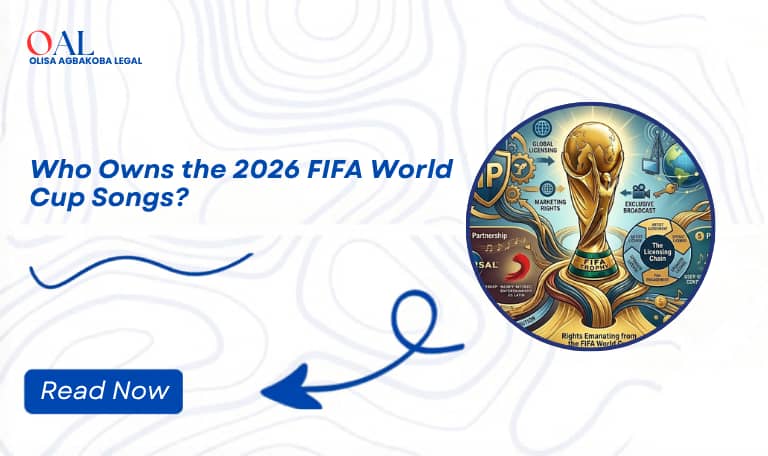
The FIFA World Cup 2026 soundtrack is already generating global attention, with artists like Shakira, Burna Boy, Davido, and Rema featured on a star-studded 18-track project tied to the tournament. Yet, behind the global buzz sits a complex legal question: who actually owns the sound of the FIFA World Cup 2026?
The answer is rarely straightforward. In most cases, ownership is not held by a single party but is split across multiple stakeholders. Artists, producers, music publishers, and record labels typically retain different layers of copyright, while FIFA and its partners operate through licensing agreements that grant limited rights of use. What appears to the public as a single unified soundtrack is, in legal terms, a carefully structured web of contracts and divided intellectual property rights.
The 2026 FIFA World Cup Soundtrack and Its Global Collaboration
The FIFA World Cup 2026 soundtrack reflects the global nature of modern football culture. It brings together artists across Africa, Latin America, Europe, and the United States in a highly commercialised music project tied to one of the world’s most-watched sporting events.
Among the featured contributors are Shakira, Burna Boy, Davido, Rema, Ayra Starr, Tyla, 21 Savage, The Rolling Stones, and IShowSpeed. The project is designed not just as entertainment, but as a global branding tool linked to the tournament.
This scale of collaboration is exactly what makes ownership questions more complicated from an intellectual property perspective.
Who Actually Owns World Cup Music Rights?
In music law, ownership is not singular. It is divided into layers of rights, each controlled by different parties under contractual agreements.
The master recording is usually owned by the record label or the commissioning entity, unless an artist negotiates ownership directly. The songwriting and composition rights are split among writers, producers, and composers according to agreed-upon percentages.
FIFA itself typically does not own the music outright. Instead, it acquires limited licensing rights that allow it to use the songs across broadcasts, marketing campaigns, digital platforms, and tournament branding.
This means what the public experiences as a unified soundtrack is, in legal reality, a network of fragmented rights governed by multiple contracts.
The Legal Risks Behind Global Sports Music
Large-scale sporting events like the FIFA World Cup operate at the intersection of entertainment, branding, and intellectual property law. This creates recurring legal risks that are often overlooked in the excitement of release.
One major issue is unclear ownership splits among collaborators, especially when songs involve multiple international artists and producers. Without precise contractual agreements, disputes over royalties can emerge long after a song becomes commercially successful.
Another common issue is sample clearance. Modern global music often blends genres such as Afrobeats, Latin pop, and hip-hop, increasing the likelihood that underlying samples or influences are not properly cleared.
There is also the issue of synchronisation licensing. Brands and broadcasters that use World Cup songs in advertisements or campaigns must obtain proper legal permission. Without it, they risk copyright infringement claims.
These issues do not usually appear at launch. They surface later, when the music has already become commercially valuable.
The ‘Waka Waka’ Precedent and Why History Still Matters
The legal debate around World Cup music is not new. A well-known example is Shakira’s “Waka Waka (This Time for Africa),” the official song of the 2010 FIFA World Cup in South Africa.
The track later attracted controversy after it was revealed that its chorus drew inspiration from “Zamina mina (Zangaléwa)” by the Cameroonian group Golden Sounds. Although the matter was eventually settled and credits were adjusted, it exposed a long-standing issue in global music production: cultural borrowing without immediate legal clarity.
That case remains relevant today because the structure of global collaborations has become even more complex, not less.
Why African Artists Face Greater Exposure in Global Deals
African artists are now central to global music projects, and the FIFA World Cup 2026 soundtrack reflects that shift. Artists such as Burna Boy, Davido, and Rema are no longer peripheral contributors; they are key global collaborators shaping mainstream sound.
However, increased visibility often comes with increased contractual risk. In many cases, the excitement of global recognition overshadows detailed negotiation of rights, including ownership of masters, publishing splits, and long-term royalty structures.
In intellectual property terms, exposure without control can become a long-term disadvantage if agreements are not carefully structured from the outset.
What Makes This Different From Ordinary Music Releases
A project linked to the FIFA World Cup is not an ordinary album release. It is a commercial ecosystem tied to one of the world’s most valuable sports brands.
Every track is potentially used across broadcasts, advertisements, sponsorship activations, and digital campaigns. That means each song operates as both a creative product and a licensing asset.
Because of this dual function, legal clarity becomes essential. Every usage right, territory restriction, and licensing permission must be clearly defined before release, not after commercial success.
Conclusion
There is no single owner of the FIFA World Cup 2026 soundtrack. Ownership is distributed across multiple stakeholders, including artists, producers, publishers, labels, and FIFA’s licensing partners. What appears to the public as a unified global album is, in legal reality, a carefully negotiated structure of fragmented rights.
The real issue is not just ownership. It is whether all parties fully understand the contracts behind the music before it becomes global property. Because in intellectual property law, the celebration ends, but the contract continues.
At Olisa Agbakoba Legal (OAL), our Sports, Entertainment and Technology practice advises artists, brands, and rights holders on intellectual property structuring, licensing agreements, and commercial rights in global entertainment deals. We operate at the intersection of music, sport, and law, helping stakeholders protect value before disputes arise. to building a Nigeria that finally works.