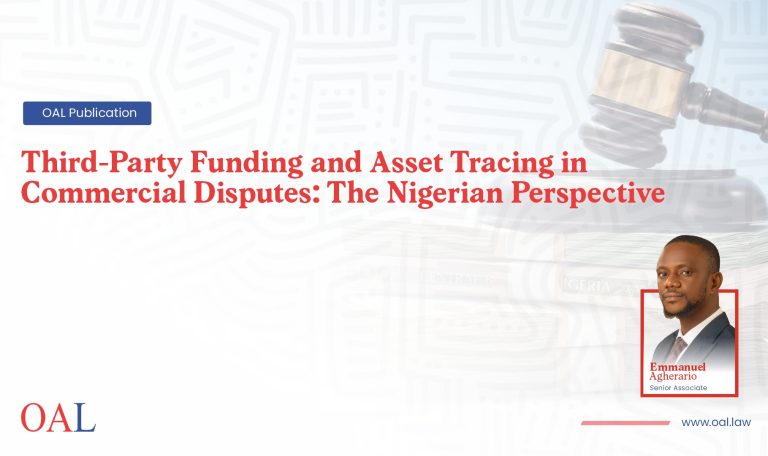
Commercial dispute resolution in Nigeria is undergoing a quiet but significant transformation. While traditional litigation remains dominant, two concepts are increasingly shaping high-value commercial and cross-border disputes: third-party funding (TPF) and asset tracing. These tools sit at opposite ends of the dispute lifecycle: funding determines whether a claimant can fight, while asset tracing determines whether a victory can actually be enforced.
Yet, in Nigeria, both concepts operate within a complex legal environment shaped by inherited common law doctrines, evolving statutory reforms, and judicial caution. Understanding how Nigerian courts have treated related principles such as champerty, maintenance, and asset preservation orders is essential to appreciating the current position.
Third-Party Funding and the Nigerian Legal Position
Third-party funding refers to arrangements where a non-party finances litigation or arbitration in exchange for a share of the proceeds. Globally, it has become an important mechanism for improving access to justice in high-value disputes, particularly where claimants are asset-rich in claim but cash-poor in funding.
Historically, Nigerian law took a restrictive approach due to the common law doctrines of maintenance and champerty, which were received into Nigerian jurisprudence as part of English law. These doctrines generally prohibited third parties with no legitimate interest in a dispute from funding litigation for profit.
This position was reflected in judicial authorities such as Oloko v Ube (2001) 1 NWLR (Pt 729) 161, where the Court of Appeal held that agreements which allow a party to fund litigation in exchange for a share of the proceeds are champertous and therefore unenforceable. Similarly, in Egbor & Anor v Ogbebor (2015) LPELR-24902 (CA), the Court reaffirmed that while not every form of assistance amounts to champerty, arrangements that amount to commercialised litigation funding remain legally impermissible under traditional doctrine.
However, this position has now been significantly rebalanced by legislative reform. The enactment of the Arbitration and Mediation Act 2023 marks a major turning point in Nigeria’s dispute resolution framework. The Act expressly introduces a modern regime for third-party funding in arbitration and related proceedings. In particular:
The AMA 2023 abolishes the common law torts of maintenance and champerty in relation to third-party funding of arbitration, thereby removing the traditional legal barrier to funding arrangements in arbitral proceedings seated in Nigeria.
This development means that third-party funding agreements are now valid, lawful, and enforceable in arbitration contexts governed by Nigerian law, including related court proceedings arising from such arbitrations.
In addition, the Act introduces transparency safeguards. Where funding arrangements exist, disclosure obligations may arise, and under Section 62(3) AMA 2023, if a party seeks security for costs on the basis of funding, the funded party may respond with evidence (including affidavit evidence) confirming the existence and scope of the funding arrangement and the funder’s commitment to adverse costs exposure.
This reform places Nigeria within the growing group of arbitration-friendly jurisdictions that recognise third-party funding as a legitimate feature of modern dispute resolution, while still preserving judicial control over abuse of process.
However, it is important to note that this liberalisation is, at present, most clearly applicable to arbitration. In court litigation, the traditional common law concerns around champerty and maintenance have not been expressly abolished in the same comprehensive manner, leaving a degree of doctrinal uncertainty in purely litigation-based funding arrangements.
Asset Tracing and Enforcement in Nigerian Commercial Litigation
While funding determines access to justice, asset tracing determines the practical value of justice obtained. In Nigeria, asset tracing has become increasingly important in commercial disputes involving fraud, breach of contract, shareholder disputes, and enforcement of foreign arbitral awards.
At its core, asset tracing involves identifying and preserving assets that may otherwise be concealed, dissipated, or transferred across jurisdictions. Nigerian courts have long recognised the importance of asset preservation mechanisms, particularly through equitable reliefs designed to prevent judgment frustration.
One of the most significant tools in this regard is the Mareva injunction (freezing order), first recognised in Nigerian jurisprudence through English common law principles. Although not originally Nigerian in origin, it has been firmly adopted and applied by Nigerian courts to prevent the dissipation of assets pending litigation.
In Trade Bank Plc v. Benilux (Nig.) Ltd. (2003) 9 NWLR (Pt. 825) 416 the Court of Appeal affirmed the principle that courts have the power to grant injunctive relief to preserve the subject matter of litigation where there is a real risk that a defendant may frustrate the enforcement of a future judgment. The decision reflects the Nigerian courts’ willingness to adopt equitable remedies where necessary to protect the integrity of the judicial process.
The Supreme Court has also reinforced the principle that equitable remedies, including injunctions, are discretionary and must be exercised judicially and judiciously. In Kotoye v. CBN (1989) 1 NWLR (Pt 98) 419, the Court emphasised that injunctions are designed to maintain the status quo and prevent irreparable harm pending the determination of the substantive dispute.
In practice, Nigerian courts have increasingly granted freezing orders where claimants demonstrate a risk of asset dissipation, particularly in cases involving commercial fraud or cross-border financial misconduct. However, enforcement remains a significant challenge, especially where assets are moved offshore or layered through complex corporate structures.
The Intersection Between Funding and Asset Tracing
Although third-party funding and asset tracing operate at different stages of litigation, they are increasingly interdependent in modern commercial disputes.
Funders are not merely interested in the legal strength of a claim; they are equally concerned with enforcement viability. A strong legal case without identifiable assets is commercially unattractive. As a result, asset tracing has become an implicit precondition for funding decisions.
In practical terms, funders assess:
- Whether the defendant has identifiable assets within enforceable jurisdictions
- Whether those assets can be preserved through freezing orders
- Whether there is evidence of past asset dissipation or concealment
- Whether enforcement would require complex cross-border proceedings
This means that in modern dispute practice, asset tracing is no longer a post-judgment exercise. It is a pre-litigation and pre-funding investigative tool that determines whether a claim is worth pursuing at all.
Cross-Border Enforcement Challenges
The globalisation of commerce has significantly complicated both funding and asset tracing in Nigerian disputes. Defendants frequently structure assets through offshore companies, trusts, and nominee arrangements, making enforcement difficult even after successful litigation.
Nigerian courts have recognised the need for robust enforcement mechanisms, but practical challenges persist, particularly in relation to cross-border asset recovery. Mutual legal assistance processes are often slow, and by the time enforcement mechanisms are activated, assets may have already been relocated.
This challenge has been widely acknowledged in discussions on financial crime recovery, where delays in obtaining freezing orders often result in asset dissipation before enforcement can be effective. The result is a structural gap between legal victory and practical recovery.
Conclusion
Third-party funding and asset tracing now occupy central roles in Nigeria’s evolving commercial dispute ecosystem.The traditional hostility toward litigation funding under Oloko v Ube and Egbor v Ogbebor reflects the historical common law position. However, the Arbitration and Mediation Act 2023 has fundamentally reshaped the landscape by abolishing champerty and maintenance in arbitration contexts and formally recognising third-party funding as a legitimate dispute financing mechanism.
At the same time, Nigerian courts, through decisions such as Kotoye v CBN and Trade Bank Plc v Barilux, have consistently reinforced the importance of asset preservation through equitable remedies such as injunctions and freezing orders.Ultimately, the effectiveness of commercial dispute resolution in Nigeria is no longer determined solely by legal success. It is increasingly defined by the ability to finance claims, trace assets, preserve value, and ensure enforceability. In modern practice, litigation is no longer just about winning disputes. It is about converting legal rights into recoverable, enforceable, and financially meaningful outcomes.
Reference
- Trade Bank Plc v Barilux (Nig) Ltd (2003) 9 NWLR (Pt 825) 416.
- Bassey, Utibeabasi, Third Party Funding Under The Nigerian Arbitration And Mediation Act, 2023-A Comparative Analysis With The Legal Systems Of India, Hong Kong And Singapore (April 07, 2025). Available at SSRN: https://ssrn.com/abstract=5216193 or http://dx.doi.org/10.2139/ssrn.5216193
- https://www.whitecase.com/insight-alert/new-arbitration-regime-comes-force-nigeria
- https://www.mondaq.com/nigeria/arbitration-dispute-resolution/1638794/a-review-of-the-arbitration-and-mediation-act-2023-charting-a-new-course-in-nigeria
- https://www.mondaq.com/nigeria/arbitration-dispute-resolution/1183162/arbitration-in-nigeria-an-expos%C3%A9-on-its-cost-and-expenses
- https://www.ibanet.org/third-party-funding-Nigeria-arb-proceedings
- https://www.ciarb.org/media/xbbegf1e/guidelines-on-third-party-funding_-published-final.pdf
- Egbor & Anor v Ogbebor (2015) LPELR-24902 (CA).
- Kotoye v Central Bank of Nigeria (1989) 1 NWLR (Pt 98) 419.
- Oloko v Ube (2001) 1 NWLR (Pt 729) 161.