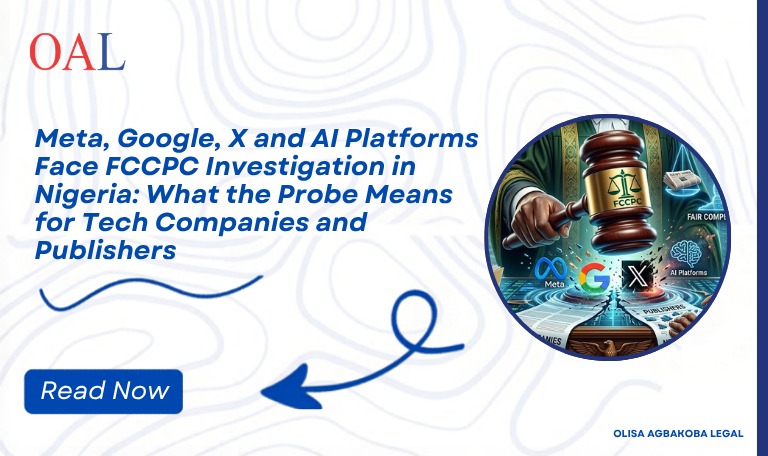
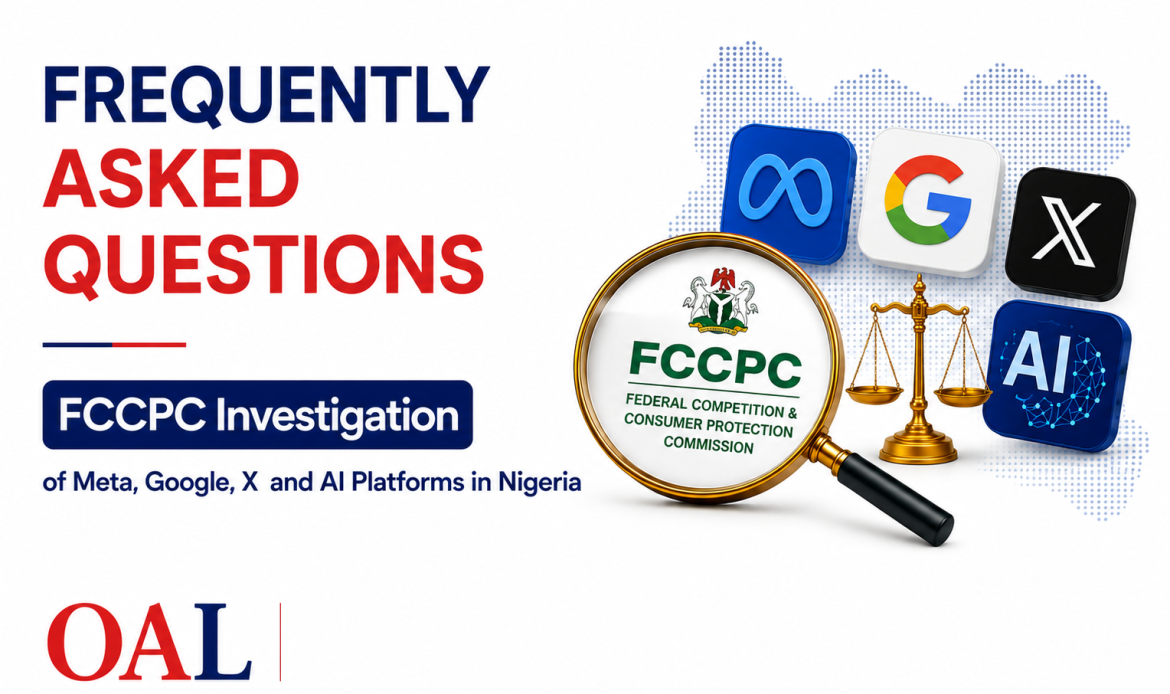
The FCCPC investigation into Meta, Google, X and AI platforms has brought Nigeria into the global debate over Big Tech, artificial intelligence and the future of journalism — and this time, the stakes are local.
In July 2026, President Bola Ahmed Tinubu directed the Federal Competition and Consumer Protection Commission (FCCPC) to investigate allegations involving major technology companies, including Meta, Alphabet (the parent company of Google), X (formerly Twitter), and generative AI platforms operating in Nigeria. The directive was officially transmitted to the Commission by the Honourable Minister of Information and National Orientation, Alhaji Mohammed Idris.
The investigation follows complaints concerning alleged anti-competitive practices, unauthorised commercial use of news content, and potentially unfair treatment of Nigerian media organisations. The investigation is ongoing. The allegations are not findings that any company has violated Nigerian law.
But here is what matters to you: if you run a technology company, an AI startup, a media organisation, a digital platform, or any content-driven business, this probe could change how you collect, use, distribute, and monetise online content. And it raises a question that cuts to the heart of the digital economy — who should benefit when platforms and AI systems generate commercial value from journalism?
Background: Why Nigeria Is Investigating Meta, Google, X and AI Platforms
On July 6, 2026, the FCCPC‘s Director of Corporate Affairs, Ondaje Ijagwu, announced the commencement of the investigation. The inquiry follows a joint petition submitted to the Presidency by the Nigerian Press Organisation (NPO), an umbrella coalition representing:
- NPAN (Newspaper Proprietors’ Association of Nigeria)
- NGE (Nigerian Guild of Editors)
- NUJ (Nigeria Union of Journalists)
- BON (Broadcasting Organisations of Nigeria)
- GOCOP (Guild of Corporate Online Publishers)
The investigation is expected to examine allegations involving market dominance, anti-competitive conduct, unauthorised use of copyrighted news content, and the use of journalistic materials in training generative AI systems.
Think about what that means in practice. Every time an AI tool summarises a news story, answers a question using a journalist’s research, or surfaces content to a user without sending them to the publisher’s website, a value exchange occurs — but the publisher may see nothing from it. The probe reflects that growing frustration.
Technology companies, for their part, may argue that search engines and social media platforms help publishers reach wider audiences and improve access to information. Both sides have a point. The challenge is finding a legal and commercial balance that supports innovation while protecting fair competition and sustainable journalism.
Why the FCCPC Investigation Matters
Consider how much of what you read online reaches you through Google, Meta, or X. For many people, these platforms are the internet — the primary way they discover and consume news. That reach gives these companies enormous influence over what publishers can and cannot earn.
Many Nigerian media organisations depend on these platforms for website traffic, advertising revenue, and audience access. A change to a search algorithm or a content-distribution policy is not an abstract technical update. For a publisher, it can be the difference between survival and shutdown.
Generative AI deepens the problem. When an AI tool provides a direct answer drawn from a journalist’s work — without the user ever visiting the original article — the publisher loses the click, the ad impression, and the chance to build a reader relationship. Multiply that across millions of queries a day and the commercial damage becomes significant.
This is precisely what the FCCPC is now tasked with examining: whether major platforms hold unchecked market power, and whether Nigerian publishers have ever had a fair seat at the negotiating table.
1. Competition Law and the Market Power of Big Tech
Nigeria’s principal competition legislation is the Federal Competition and Consumer Protection Act (FCCPA) 2018. The Act prohibits certain anti-competitive agreements and the abuse of a dominant market position.
Regulators have made it clear that they are willing to impose heavy enforcement actions under this framework. For context, in July 2024, the FCCPC slammed Meta with a landmark $220 million administrative penalty (alongside $35,000 in investigative costs) for data privacy violations and market abuse. This historic fine was subsequently upheld in April 2025 by the Competition and Consumer Protection Tribunal (CCPT), though Meta continues to contest the decision.
To be clear: a company does not break competition law simply by being large, successful, or influential. Market dominance is not automatically unlawful. The legal concern arises where substantial market power is used to restrict competition, exclude businesses, or impose unfair commercial conditions. Size, in other words, is not the offence. What you do with it may be.
The investigation, led by FCCPC Executive Vice Chairman and CEO Tunji Bello, may consider:
- Whether Major Platforms Control Important Channels for News Distribution
- Whether Nigerian Publishers Can Negotiate Meaningful Commercial Terms
- Whether Platform Policies Unfairly Affect Publishers’ Visibility or Revenue
- Whether Similar Publishers Receive Different Treatment Without Objective Reasons
- Whether the Use of News Content Strengthens the Market Position of Digital Platforms
If you are building a Nigerian technology business, pay attention. These are not just issues for the global giants. As your platform grows, competition compliance needs to become part of how you govern your company and structure your commercial relationships — not an afterthought.
2. Can AI Platforms Use News Articles Without Permission?
This is perhaps the most urgent legal question of the AI era. And the honest answer is: it depends.
News articles can attract copyright protection where they contain original expression. Copyright may protect the language, structure, analysis, photographs, graphics, and other original elements of an article. What it does not protect are the underlying facts, events, or ideas. You can report on a fire. You cannot own the fire.
The issue becomes far more complex when an AI company collects vast amounts of online content to train or improve its models. Was that collection lawful? Did any licence permit it? Does the AI output reproduce protected elements of the original work? These are not rhetorical questions — they are the specific issues regulators and courts are now being asked to resolve.
Important questions include:
- Was the Content Obtained Lawfully?
- Was Permission Required or Obtained?
- Did a Licence or Website Term Permit the Use?
- Was the Content Copied or Stored During AI Training?
- Does the AI Output Reproduce Protected Parts of the Work?
- Does the Use Affect the Commercial Market for the Content?
Nigeria’s Copyright Act 2022 provides the legal framework for protecting eligible copyright works. Courts and regulators worldwide are still working out how those principles apply to large-scale AI training. What is already clear is this: technology companies should not assume that publicly accessible content is free content. That assumption is becoming increasingly expensive.
3. What the FCCPC Investigation Means for Nigerian Publishers
If you are a broadcaster, an online publisher, or own a news media organisation, this investigation is, in a real sense, about you. It creates a moment to review how your digital content is owned, protected, and monetised — and to act before the rules are set without your input.
Publishers should:
- Clarify Copyright Ownership: Employment and freelance agreements should state who owns articles, photographs, videos, and other materials.
- Review Website Terms: Terms of use should explain whether automated collection, commercial reuse, or AI training is permitted.
- Develop Content-Licensing Models: Licensing agreements can define how technology companies may use content, the permitted duration, and whether compensation is required.
- Maintain Evidence: Publishers should preserve publication records, original files, ownership agreements, and evidence of suspected unauthorised use.
- Assess Technical Controls: Technical measures may help manage automated access to websites, although they should support rather than replace legal protection.
The investigation does not guarantee that Nigerian publishers will receive compensation. But it may well produce clearer rules on licensing, transparency, and the economic value of journalism that the industry has long needed.
4. What Nigerian AI Startups Must Know
Do not make the mistake of thinking this investigation only concerns the global giants — Meta, Google, and X. If you are building an AI product in Nigeria, the legal questions being examined apply directly to you.
Your startup may use online articles, books, images, videos, and databases to develop its products. Where you collect or use protected content without properly assessing ownership and licensing requirements, you carry legal risk — risk that can surface at the worst possible moment, such as during investor due diligence or a regulatory inquiry.
Before using third-party content, ask yourself:
- Who Owns the Content?
- Do We Have Permission to Collect and Use It?
- Does the Licence Cover AI Training?
- Can We Identify and Document Our Data Sources?
- Can Rights Holders Raise Objections or Request Removal?
- Could Our AI Outputs Reproduce Protected Content?
Keep records of your training-data sources and licences. Investors will look at these. Uncertain rights to training data translate directly into litigation risk, regulatory exposure, and commercial vulnerability. Get ahead of it now, not after the problem finds you.
5. Global Precedents: France and South Africa
Nigeria is not alone in this fight — and what is happening elsewhere tells us where this is heading.
In France, the Autorité de la concurrence ordered Meta to resume negotiations and submit a payment proposal to French media groups seeking fees for the online use of their content. The dispute concerns “neighbouring rights” under European law, which provide a framework for compensating press publishers for certain digital uses of their publications.
Closer to home, the South African Competition Commission launched a landmark digital markets inquiry into how major search engines and social media platforms impact local news publishers. As a result of this regulatory intervention, Google agreed to a settlement package of R688 million (approximately $40 million)
These cases show that disputes over payments for news content are now being framed as competition law violations — and African regulators are increasingly willing to act on them.
6. The United Kingdom: AI Copyright Rules Remain Under Review
Look also to the United Kingdom, where the same tension is playing out at the policy level.
In March 2026, the UK Government published a report examining how copyrighted works are used in developing AI systems. The report followed a public consultation and considered licensing, transparency, access to training data, and the economic effect of possible legal reforms. After all of that, the government did not adopt a final preferred policy option.
What that tells us is not that nothing is happening — it is that the stakes are so significant that even well-resourced governments are moving carefully. The debate over how to encourage AI development without undermining the rights and commercial interests of authors, journalists, publishers, and creators is far from settled.
For Nigeria, the lesson is clear: AI policy cannot be about innovation alone. Consent, transparency, intellectual property protection, and the sustainability of local creative industries must all be part of the conversation.
7. What Technology Companies Should Do Now
If you operate a technology company in Nigeria, treat the FCCPC investigation not as a threat to manage quietly but as a signal to act on now. The companies that will be best positioned — legally, commercially, and reputationally — are the ones that do not wait to be investigated before reviewing their practices.
Important steps include:
- Audit Content Sources: Identify the articles, images, videos, and databases used by your platform or AI systems.
- Review Licences and Permissions: Confirm that agreements permit the intended commercial use, including AI training where applicable.
- Assess Competition Risks: Review platform policies, commercial terms, and relationships with publishers.
- Improve Transparency: Explain how content is collected, processed, displayed, or used to develop AI products.
- Create Rights-Management Procedures: Provide effective channels through which copyright owners can raise concerns.
- Review Commercial Agreements: Contracts with publishers, creators, developers, and data providers should address ownership, licensing, and liability.
- Prepare for Regulatory Enquiries: Maintain records showing how important content-use and commercial decisions were made.
Early compliance reduces regulatory, litigation, and reputational risks. But it does something else too — it builds the kind of trust with publishers, users, and investors that is very difficult to reconstruct once it has been lost. Speak to our team before the investigation reaches your door.
Frequently Asked Questions
- Why Is Nigeria Investigating Meta, Google, X and AI Platforms?
The investigation follows a directive from President Bola Ahmed Tinubu triggered by a joint petition from local media bodies (NPAN, NGE, NUJ, BON, and GOCOP). It looks into allegations involving anti-competitive practices, unauthorised commercial use of news content, and potentially unfair treatment of Nigerian media organisations. The allegations have not been established as legal violations. Read more about competition compliance in Nigeria.
- Can My AI Company Use Online Articles for Training?
The answer depends on copyright ownership, licences, website terms, how the content was obtained, and the intended use. You should conduct a legal review before using large collections of online content commercially.
- Can My Media Company Demand Payment From AI Platforms?
Your rights may depend on applicable law, ownership of the content, and how the platform uses it. The FCCPC investigation may provide further regulatory direction but does not automatically create an immediate right to payment. Olisa Agbakoba Legal can advise on your options under current Nigerian law.
- How Can I Protect My News Content From Unauthorised AI Use?
You should clarify copyright ownership, review website terms, maintain evidence of publication, assess technical controls, and consider appropriate content licensing arrangements.
Conclusion
Nigeria’s investigation into Meta, Google, X and generative AI platforms is not just a regulatory story. It is a story about who controls the value chain of information — and whether those who create that value will ever be fairly compensated for it.
Technology companies need access to reliable information to build useful products. Publishers, journalists, and creators need sustainable ways to protect and earn from the work they produce. These are not opposing interests. They are interests that a well-designed digital market should be able to serve simultaneously.
The challenge is not to choose between technology and journalism. It is to build a digital market where innovation, fair competition, and intellectual property rights grow together — and where Nigerian voices, Nigerian content, and Nigerian businesses are not left behind while others profit from them.
For technology companies, AI startups, and publishers, early legal advice can make the difference between being caught off guard and being ready. Olisa Agbakoba Legal (OAL) can assist technology companies, AI businesses, publishers, and content creators with competition law, copyright protection, content licensing, technology agreements, regulatory compliance, and AI legal risk management.
Disclaimer: This article provides general information and does not constitute legal advice. You should seek professional legal advice based on your technology, content, business model, and regulatory obligations.