
Author: newoal

  • Nigerian Lawyers in a Globalised Legal Economy: An International Lawyers’ Day Reflection

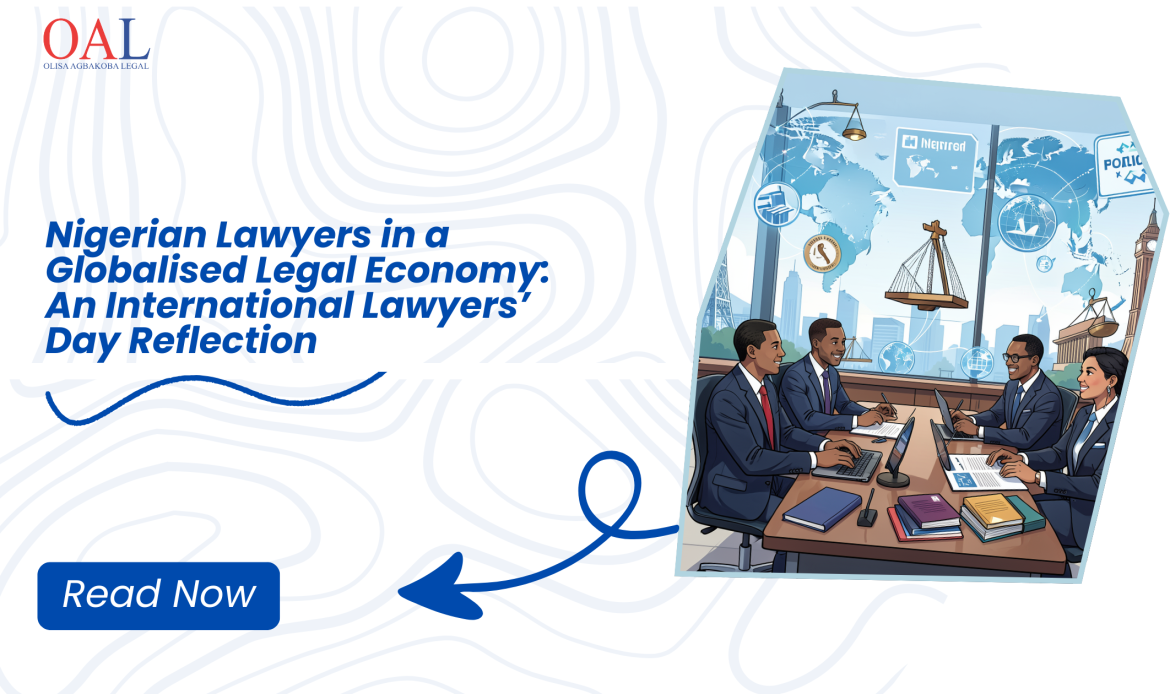
    Nigerian Lawyers in a Globalised Legal Economy: An International Lawyers’ Day Reflection

    Nigerian Lawyers in a Globalised Legal Economy: An International Lawyers’ Day Reflection

    The practice of law has evolved into a profession no longer confined by borders. In today’s globalised legal economy, lawyers operate within an interconnected system shaped by cross-border trade, international regulation, technology, and global standards of governance. For Nigerian lawyers, this reality presents both unprecedented opportunities and complex challenges.

    International Lawyers’ Day offers a moment not merely to celebrate the legal profession, but to reflect on how Nigerian lawyers are evolving to meet the demands of a global legal order (one in which competence, credibility, and collaboration matter more than geography).

    The Globalisation of Legal Practice

    Globalisation has fundamentally altered how law is practised. Transactions now span multiple jurisdictions. Regulatory compliance must satisfy both local and international standards. Disputes are increasingly resolved through international arbitration rather than domestic courts. Data, capital, and intellectual property move across borders with speed and scale.

    As a result, modern legal practice demands:

    1. An understanding of international legal frameworks
    2. Familiarity with cross-border regulatory regimes
    3. The ability to advise clients operating in multiple jurisdictions
    4. Strategic thinking that goes beyond domestic law

    Nigerian lawyers are no longer competing only within Nigeria. They are competing and collaborating on a global stage.

    In response to these shifts, leading Nigerian law firms are modifying their practice models to meet cross-border complexity and international expectations.

    For instance, leading Nigerian law firms such as Olisa Agbakoba Legal (OAL) reflect this evolution. They are aligning legal advisory services with global regulatory developments, international best practices, and multidisciplinary expertise. This institutional approach illustrates how Nigerian legal practice is adapting to globalisation, not by abandoning local relevance, but by integrating it with global competence.

    Nigeria’s Place in the Global Legal Economy

    Nigeria occupies a strategic position in Africa’s economic landscape. As one of the continent’s largest economies, with a growing technology sector, expanding capital markets, and increasing foreign investment, Nigeria sits at the intersection of local opportunity and global interest.

    This reality places Nigerian lawyers in a critical role:

    1. Advising multinational corporations entering the Nigerian market
    2. Supporting Nigerian businesses expanding abroad
    3. Navigating regulatory frameworks that intersect with international law
    4. Managing disputes involving foreign parties, investors, and governments

    Within this context, the role of Nigerian law firms extends beyond providing technical advice to serving as an institutional bridge-builder.

    Olisa Agbakoba Legal (OAL), a top Nigerian law firm, operates at this intersection, advising on matters that require a deep understanding of Nigeria’s legal environment alongside sensitivity to international standards, investor expectations, and cross-border regulatory norms. This positioning reflects the growing importance of Nigerian firms that can translate global legal requirements into effective local solutions.

    The Nigerian lawyer today must therefore be both locally grounded and globally fluent.

    From Domestic Practice to Cross-Border Expertise

    Historically, many Nigerian lawyers focused primarily on litigation and domestic advisory work. While these remain essential, globalisation has expanded the scope of legal services required.

    Today’s Nigerian lawyer is increasingly involved in:

    1. Cross-border mergers and acquisitions
    2. International arbitration and dispute resolution
    3. Data protection and technology regulation
    4. Capital markets and project finance
    5. Energy, infrastructure, and international trade

    This shift requires continuous learning, exposure to global best practices, and a willingness to operate within diverse legal cultures.

    In this evolving landscape, leading Nigerian law firms are redefining what it means to practise law at a global level.

    Olisa Agbakoba Legal is one such firm positioning itself at the forefront of Nigeria’s integration into the global legal economy. Through a multidisciplinary team of experienced legal professionals, deep regulatory insight, and sustained engagement with international standards, the firm continues to advise on complex cross-border transactions, regulatory reform, and governance-driven legal solutions. This approach reflects a broader shift among top-tier Nigerian law firms toward excellence, global relevance, and institutional leadership.

    Technology as a Global Equaliser

    Technology has become one of the most powerful equalisers in the global legal economy. Nigerian lawyers now collaborate with international clients and counterparts in real-time, access global legal resources instantly, and advise on cross-border transactions without requiring physical proximity. Geographic distance is no longer a barrier to participation in global legal work.

    Similarly, technology has reshaped the substance of legal practice itself. Data protection, cybersecurity, artificial intelligence, fintech regulation, and digital governance are now central areas of legal risk and opportunity (fields shaped by global standards but applied locally). Lawyers who lack technological literacy or regulatory foresight risk falling behind in an increasingly competitive market.

    Recognising this shift, Olisa Agbakoba Legal has positioned itself at the intersection of law, technology, and regulation. The firm’s advisory work increasingly reflects the realities of a digital economy, combining regulatory insight with practical understanding of how technology-driven businesses operate locally and across borders. This mirrors a broader evolution in legal practice (one in which technological competence is no longer optional, but fundamental to credible global lawyering).

    Ethics, Governance, and Global Standards

    In a globalised legal economy, credibility is currency. International clients and partners demand not only technical expertise but also strong ethical standards, transparency, and sound governance.

    Nigerian lawyers operating globally must demonstrate:

    1. Adherence to international professional ethics
    2. Strong corporate governance awareness
    3. Compliance with anti-corruption and regulatory standards
    4. Accountability and institutional integrity

    Firms that aspire to operate credibly within this global ecosystem must align expertise with ethics and governance. At Olisa Agbakoba Legal, this philosophy informs a deliberate emphasis on institutional integrity, regulatory compliance, and professional excellence (qualities increasingly demanded by international clients, partners, and regulators alike).

    Challenges Nigerian Lawyers Must Navigate

    Despite the opportunities created by globalisation, Nigerian lawyers face persistent structural challenges. These include regulatory complexity across jurisdictions, rapidly evolving international standards, skills gaps, and a long-standing disconnect between legal theory and the realities of modern legal practice.

    One of the most significant challenges remains professional preparedness. Many lawyers are trained primarily in doctrinal law, with limited exposure to how law is practised in complex commercial, regulatory, and cross-border environments. This gap becomes more pronounced as clients demand strategic advice, industry knowledge, and a global perspective.

    In response to this challenge, Olisa Agbakoba Legal has taken a deliberate institutional approach through the OAL Academy. The Academy is designed to bridge the gap between theory and practice by teaching the law as it is practised, locally and globally. By focusing on real-world legal skills, regulatory literacy, and emerging practice areas, the OAL Academy reflects a broader commitment to building capacity within the profession and preparing lawyers for the demands of a globalised legal economy.

    The future competitiveness of Nigerian lawyers depends not only on individual brilliance but on structured, practice-oriented training aligned with global standards.

    The Opportunity Ahead

    Globalisation has not diminished the relevance of Nigerian lawyers. As a matter of fact, it has only expanded it. As Nigeria deepens its integration into global markets, the demand for lawyers who can operate confidently across jurisdictions, industries, and regulatory systems will continue to grow.

    The opportunity ahead belongs to lawyers and law firms that think institutionally rather than transactionally. The future market is law firms that invest in people, systems, and knowledge; and that understand law as a tool for governance, economic development, and value creation. It also belongs to firms that recognise their role in shaping the profession itself—not merely serving clients, but strengthening legal capacity and standards.

    Olisa Agbakoba Legal exemplifies this forward-looking approach through its advisory work, thought leadership, and commitment to professional development. By aligning legal expertise with global best practice and investing in the next generation of practitioners, the firm reflects the kind of leadership required for Nigerian law to remain relevant and competitive on the global stage.

    Conclusion

    International Lawyers’ Day is a reminder that the legal profession is both local and global. Nigerian lawyers today are no longer defined solely by domestic practice, but by their ability to operate confidently within a global legal ecosystem.

    As Nigeria continues to integrate into the global economy, industry-ready Nigerian lawyers will become essential to global economic development. Law firms that invest in talent, uphold global standards, and approach legal practice as institutional leadership (rather than transactional service) will define the future of the profession. With continued focus on legal excellence, governance, and international best practice, leading law firms like Olisa Agbakoba Legal will evolve to compete, collaborate, and lead on the global stage.


    At Olisa Agbakoba Legal, we operate at the intersection of Nigerian law and global legal standards. With a team of seasoned legal experts and a strong culture of regulatory insight and institutional leadership, we advise clients on complex cross-border matters, governance frameworks, and strategic legal risk. As the global legal economy continues to evolve, the firm remains committed to positioning Nigerian legal practice at the highest level of professional excellence.

    Disclaimer: This article is for informational purposes only and does not constitute legal advice.

  • 2026 Nigeria Tax Law: The Offences That Could Land You in Jail or Shut Down Your Business

    2026 Nigeria Tax Law: The Offences That Could Land You in Jail or Shut Down Your Business

    2026 Tax Law: The Offences That Could Land You in Jail or Shut Down Your Business

    Mama Ronke, the owner of a small provisions shop in Surulere, sat behind her counter, scrolling through WhatsApp broadcasts. “New tax law will finish us! The government wants to collect one basket out of every four baskets of tomatoes!” the message read. She sighed, filled with confusion and fear.

    However, what Mama Ronke doesn’t realise, and what many Nigerians still don’t grasp, is that the 2026 Tax Reform is not just about how much tax you pay; it’s also about the real-life consequences of breaking the law. The new regulations are structured and, in some instances, can seriously jeopardise your business and daily life.

    To help you navigate this complex landscape, let’s break down some of the key offences you need to be aware of:

    1. Unauthorised Disclosure

    Picture Kunle, a fresh-faced tax officer, who spills the beans over drinks, bragging about a major company under investigation. It seems harmless until the next morning when he learns that sharing sensitive taxpayer information could cost him up to ₦1 million, three years in prison, or both.

    The Act takes confidentiality seriously; this applies not just to officers but to businesses and individuals as well.

    2. The “Sharp Guy” Penalty (False Refund Claims)

    There’s always that one businessman who thinks he can outsmart the system. He files for a VAT refund he didn’t earn. Under the new law, this is serious business:

    • Claiming a false tax refund? Expect to repay 50% of that amount, plus interest at the CBN’s monetary policy rate.
    • A false VAT refund claim? That’s 100% of the amount, plus interest.

    The days of thinking “government money isn’t anyone’s money” are officially over.

    3. Mineral Royalties and the Big Boys’ Trap

    For companies in natural resources, failure to remit royalties now attracts a 10% penalty added to the amount due.

    If the transaction involves foreign currency? You’ll be looking at SOFR plus 10% interest. No sector is too powerful to escape regulation.

    4. The Cost of Lying (False Declarations)

    Tunde, a logistics entrepreneur, signs a tax declaration he didn’t fully read, a common Nigerian mistake.

    Under this Act, ignorance isn’t bliss. A false declaration could mean:

    • A ₦1 million administrative penalty,
    • Repayment of any undercharged tax,
    • Or even imprisonment for up to three years.

    For mining licensees or lessees, penalties can start as high as ₦10 million on the very first day of failure to remit.

    5. Forging Documents

    Counterfeiting tax documents has long been shrugged off by some, but now it carries serious repercussions:

    • An administrative penalty of ₦100,000,
    • Up to three years in prison,
    • Or a ₦1 million fine.

    It’s no longer just a backdoor; it’s an escape route that leads to serious trouble.

    6. Companies Are No Longer a Shield

    If a company commits a tax offense, the Act extends its reach beyond the corporate entity, holding individuals accountable too: directors, managers, secretaries, trustees, and even those who merely act in these roles. Unless you can prove you weren’t aware or involved, liability is squarely on your shoulders.

    7. The “General Penalty” Clause Is Waiting for Everyone Else

    If you break a rule not specifically listed, don’t think you’ll slip through unnoticed. The Act has a provision for you:

    • An administrative penalty of ₦100,000,
    • Up to three year’s imprisonment,
    • Or both. Essentially, it’s a reminder:

    If you think you’ve found a loophole, think again.

    8. When You Hold Government Money (Failure to Remit)

    Employers who deduct taxes but delay remittance need to be especially wary. The penalties include:

    • 10% per annum on the amount,
    • Interest at the CBN’s policy rate,
    • And on conviction? Up to three years in prison or fines starting from the principal amount plus an additional 50% penalty.

    Withholding taxes is treated as a sacred trust; once you’ve collected it, it’s not yours to keep.

    9. Even Your Address Matters

    Failing to notify a change of address now carries a financial penalty:

    • ₦100,000 for the first month,
    • ₦5,000 for each subsequent month.

    A simple oversight can lead to real consequences.

    10. Weapons, Violence, and Tax Enforcement

    Here’s where the Act takes a hardline approach:

    • Carrying a weapon during a tax-related offence could lead to up to five years in prison.
    • Injuring a tax officer while armed? That’s up to ten years.

    Tax compliance has crossed over into national security.

    SO, WHAT DOES THIS MEAN FOR NIGERIANS?

    Yes, there’s a cloud of fear, confusion, and a lot of misinformation. Farmers might believe the government wants a cut of their harvest, workers may fear salary cuts, and businesses might anticipate heavier burdens. Yet, according to the Tax Reform Committee, the objective is quite the opposite:

    • More exemptions for small businesses,
    • Lower taxes for low- and middle-income earners,
    • Reduced burdens for larger companies,
    • A fairer system overall,
    • And fewer overlapping taxes.

    The real threat, therefore, is not the reform itself but the misinformation and potential for non-compliance. The Nigerians who will face consequences under this new law won’t be those who honor their tax obligations, but those who inadvertently slip up on the rules.

    THE BOTTOM LINE

    Tax reform is here, and while it promises relief, transparency, and fairness, it also introduces a new era of strict accountability. Whether you are a CEO in Lekki, a tailor in Kaduna, a shop owner in Aba, or a corporate entity on Lagos Island, understanding the offences and their consequences is no longer optional; it’s essential.  For businesses, compliance could be the key to growth or the difference between success and shutdown.

    At OAL, we’re committed to breaking down the new Tax laws, so you can focus on what truly matters: running your business without fear, misinformation, or avoidable penalties.

    If you’d like OAL to help audit your compliance strategy or interpret how the new Tax Act affects your operations, our team is ready to assist.

  • Stopping the Debt Domino: Recovery Strategies for Nigerian Banks (2026)

    Stopping the Debt Domino: Recovery Strategies for Nigerian Banks (2026)

    When Debt Becomes a Domino Effect: Why Nigerian Banks Lose Billions and How Strategic Recovery Can Stop the Fall

    Every bank in Nigeria knows this story all too well.

    A loan officer approves a facility for a long-standing customer, a trusted SME owner known for never defaulting. The business seems healthy, projections are strong, and the numbers look promising. But then, six months later, the first warning sign appears: a delayed repayment. As another month passes, then two, the customer becomes increasingly unreachable, calls go unanswered, emails bounce back, and suddenly, there are “documentation issues” with the collateral. Just like that, one loan joins the growing pile of non-performing loans, silently draining the bank’s balance sheet.

    This is the daily reality for Nigerian banks, struggling to navigate economic uncertainty, foreign exchange volatility, and challenging operating environments. Borrowers sometimes misuse credit or find themselves unable to recover from market shocks. Yet, what many banks still underestimate is this critical fact:

    Debt rarely starts as a legal issue, but it often transforms into one when early interventions fail.

    At OAL, we’ve seen how a single default can trigger a domino effect: strained liquidity, stricter regulatory scrutiny, impaired assets, frustrated shareholders, and ultimately, a loss of confidence in entire lending portfolios.

    Debt Recovery Is Not About Aggression; It is About Strategy. Banks that excel in debt recovery don’t wait for the EFCC, police, or litigation to intervene. Instead, they adopt far more effective measures:

    1. Data-Led Tracing and Profiling:  Many defaulters don’t simply vanish; they just move faster than outdated recovery tactics. Accurate digital tracing, financial profiling, and asset verification can help recover loans without stepping into a courtroom.

    2. Alternative Dispute Resolution (ADR): Sometimes borrowers genuinely want to repay but find themselves stuck. Mediation and structured negotiations can often unlock repayments quicker than traditional enforcement methods.

    3. Forensic Review of Loan Documentation: Small errors in loan agreements or collateral documentation can complicate enforcement. Strong documentation is the foundation of a successful recovery strategy.

    4. Strategic Litigation When Necessary: If a borrower is evasive or fraudulent, swift, precise, and well-planned legal action can protect the bank and prevent asset dissipation. The real transformation occurs when banks move from being reactive to proactive.

    A Smart Bank Protects Its Loan Books Before Trouble Starts

    Imagine a system where:

    • Every borrower is meticulously risk-profiled.
    • Recovery frameworks activate before loans hit 30 days past due.
    • Digital tools track the movement of assets and corporate activities.
    • Loan documentation is airtight and enforceable within days.

    That’s the future top-performing banks must strive for, and it’s the system OAL can help them to build.

    Banks Don’t Need More Recovery Teams; They Need Better Recovery Systems

    Debt recovery is a discipline, a science, and a strategy grounded in law, data, negotiation, and technology. It requires the finesse of experts who understand the nuances of the Nigerian financial landscape. And every bank that adopts this approach has one thing in common: They recover faster, lose less, and protect shareholders’ value, even in a volatile economy.

    If you’re facing chronic defaults, poorly documented facilities, or silent defaulters who seem to have disappeared, OAL is here to help turn non-performing loans into recovered value. Let’s work together to secure your loan book, strengthen your recovery system, and safeguard your bottom line.

    Contact our Debt Recovery Team for a better legal solution.

  • Why Nigerian Businesses Need Arbitration Agreements (2026)

    Why Nigerian Businesses Need Arbitration Agreements (2026)

    Avoid Costly Litigation: Why Every Nigerian Business Needs an Arbitration Agreement (2026 Guide)

    If you run a business in Nigeria, you are probably familiar with this.

    It begins with a simple dispute: a supplier fails to deliver, a partner breaks an agreement, or a contractor disappears with your money. At first, you stay calm and tell your lawyer, “Let’s go to court.” After all, isn’t that what everyone does?

    Months turn into years, and before you know it, that “small case” that should have been resolved in six months is suddenly dragging into its seventh year. The judge has been transferred twice, and on many occasions, opposing counsel is “seeking adjournment.” Your file goes missing more than once, and your lawyer comes back from court with updates filled with legal jargon and technical arguments that don’t speak to your actual problem. Meanwhile, your business is suffering. Cash is tied up, time is wasted, and energy is drained.

    To make it worse, some cases in Nigeria can drag on for 10 to 20 years, with some lost in the system entirely. You start to deal with a painful truth: the court system isn’t built for the speed your business needs to survive. This is why more Nigerian businesses, big corporations, are quietly shifting to Arbitration as an effective alternative solution.

     Why Arbitration Is the Smart Business Move

    Imagine resolving your dispute in months, not decades and avoiding endless adjournments, ego battles, and legal theatrics that too often overshadow the real issues in dispute. Exactly, that’s what arbitration offers: a modern case-management system built for results, not drama.

    Here are the benefits:

    1. Dispute Fast Resolution

    Most business disputes can be resolved in under a year, especially when handled by an experienced law firm. There are no lost files, no judge transfers, and no unnecessary motions. Just the issues at hand and the solutions.

    2. You Choose the Decision-Makers

    Instead of relying on a random judge who may be juggling a heavy docket, you can select experienced Arbitrators who understand your industry.

    3. Zero Drama, Zero Noise

    No public display of drama, no shouting about “the case,” and no adjournments because someone forgot a wig. Arbitration is private, calm, and focused. Everything is confidential.

    4. Focus on What Matters

    Litigation is often bogged down by rules, filings, procedures, and loopholes. Arbitration gets straight to the heart of the matter.

    5. Protect Your Business Relationships

    Arbitration is designed to minimise hostility. Instead of damaging partnerships through prolonged fights, it fosters an environment conducive to resolution.

    6. Keep Your Business Moving

    Because of its speed, structure, and minimal disruptions, you can concentrate on running your business while the dispute is managed, without draining your team or finances.

    7. Encourages Discipline

    When your opponent realises you have a strong arbitration agreement, they become more careful and cooperative.

    At OAL, arbitration is our first choice for resolving commercial disputes. It consistently delivers more wins, satisfied clients, and predictable outcomes than litigation. Of course, there are circumstances where litigation is unavoidable, and when that happens, we litigate with full vigour.

    No dispute resolved through Alternative Dispute Resolution (ADR) at OAL has ever lasted up to a year, not one. We have assisted clients in resolving disputes and provided effective solutions all in good time.

    Conclusion:

    If you’re tired of waiting, fed up with courts, and weary of losing time and money, then arbitration is your best bet.

    OAL has experienced Counsel and Arbitrators who provide effective solutions

    Reach out to our experts today; we’re ready when you are.

  • No-Fault Divorce Strategy for Nigerian Professionals, Protect Your Business & Reputation

    No-Fault Divorce Strategy for Nigerian Professionals, Protect Your Business & Reputation

    NO-FAULT DIVORCE STRATEGY OVER COURT BATTLES

    For many couples in Nigeria, divorce often begins when couples stop communicating. It can start with small misunderstandings and unspoken resentments, growing into financial disagreements, leading to deeper emotional rifts. For business owners and professionals, the pressure intensifies. A turbulent home can disrupt boardrooms, hinder decision-making, and negatively affect productivity and finances. We’ve witnessed CEOs lose their focus during crucial mergers, entrepreneurs put expansion plans on hold, and successful executives make costly mistakes, all due to a messy divorce brewing at home.

    But what if divorce didn’t have to feel like a war?

    What if, rather than placing blame, we focused on structure? Instead of chaos, what if we embraced clarity?

    This is where the concept of “no-fault divorce strategy” becomes essential. Although Nigeria’s Matrimonial Causes Act does not explicitly recognise “no-fault divorce” as seen in some other countries, the principles behind it, amicability, reduced blame, negotiated outcomes, and minimal conflict, remain powerful tools for navigating this challenging chapter in life. For business-minded individuals, this approach evolves into not just a legal strategy but also a means of stress management and reputation preservation.

    A no-fault divorce strategy shifts the focus from assigning blame to asking, “How can we move forward in the cleanest, fastest, and fairest way?” It prioritises the needs of children, safeguards assets, respects privacy, and ultimately preserves time, which is our most valuable resource. Instead of engaging in lengthy court battles, couples can resolve critical issues like custody, maintenance, and asset division through negotiation, mediation, or tailored agreements.

    Traditionally, couples try to prove their reasons for divorce by accusing one another of misconduct, adultery, cruelty, desertion, or other allegations that can quickly escalate into a bitter, messy battle.

    A No-Fault Divorce Strategy removes this hostility entirely.

    Instead of blaming each other, both parties simply tell the court that they have lived apart for a continuous period of at least 2 years but not more than 3 years, and that there is no reasonable likelihood of getting back together. This falls under one of the recognised grounds for proving the breakdown of marriage under the Matrimonial Causes Act. This approach is cleaner, faster, and dramatically less traumatic for everyone involved, especially children.

    Here’s what it avoids:

    • No accusations of adultery.
    • No allegations of cruelty or misconduct.
    • No emotional damage to children who later read the court records.
    • No public scandal or detailed filings that outsiders can access.
    • No years of court battles draining finances and mental energy.

    And here’s what it protects:

    • Your reputation.
    • Your privacy.
    • Your business interests.
    • Your long-term financial stability.
    • Your children’s emotional well-being.
    • Your peace of mind.

    With a no-fault strategy, the couple focuses on resolution, not revenge. They work through key issues, custody, maintenance, and property division through structured negotiation, mediation, or a carefully drafted settlement agreement.

    At OAL, we understand how messy divorce or separation can affect the lives of children and the future of the parties. We have successfully guided numerous high-net-worth individuals, entrepreneurs, and professionals through peaceful, structured divorces/separations. Many approached us fearing scandal, asset loss, or a prolonged court process. However, with the no-fault divorce strategy, open communication, mediation, arbitration, and meticulous settlement agreements, along with, where applicable, prenuptial or postnuptial contracts, they walked away with their dignity intact and business interests protected.

    If you are at a crossroads in your marriage and want a calm, structured, and discreet process, one that protects your peace, your children, and your legacy, speak with our Family Law team.

  • How IP Can Increase SMEs’ Contribution to Nigeria’s Economy

    How IP Can Increase SMEs’ Contribution to Nigeria’s Economy

    How IP Can Increase SMEs’ Contribution to Nigeria’s Economy

    Over 90 percent of businesses in Nigeria are small and medium-scale enterprises (SMEs). These businesses contribute approximately 48 percent of Nigeria’s gross domestic product and 84 percent of national employment. In 2025, Nigeria declares that a $1 trillion economy is achievable by 2030 through these SMEs. However, this ambition will remain far from reality if the intellectual property (IP) rights issues facing SMEs are not addressed. These IP issues include imitation, theft, and commercial exploitation. For Nigeria to fully maximize the economic potential of SMEs, IP education must be a top priority. Also, a centralized and stricter enforcement agency must be instituted. 

    Many Nigerian SMEs mostly focus on profit-making, while neglecting what becomes of their financial asset (intellectual property). Unfortunately, some SMEs still suffer from commercial exploitation due to weak enforcement despite protecting their work.

    With Nigerian SMEs already battling with limited access to funds, if these problems persist, investment in SMEs would be discouraged, and innovation would decline. The contribution of Nigerian SMEs to Nigeria’s GDP would also reduce.

    Intellectual property rights education is non-negotiable for resolving these IP issues. Nigerian entrepreneurs cannot protect what they lack the knowledge of. Also, Nigerian consumers cannot value IP when they are ignorant of its economic importance. Although Nigeria currently has awareness programs for IP, these programs are fragmented and insufficient.

    Compared to countries like the United Kingdom, Nigeria has not institutionalized IP literacy into its formal education to increase awareness. The UK has an IP Education Framework designed for primary and secondary schools, as well as universities. This framework provides free resources for students, businesses, business advisors, and lecturers on how to manage or use IP. The framework also provides lesson plans for lecturers, teachers, and tutors, exposing students to the usefulness of IP in their lives and future careers. 

    IP education should be incorporated into educational institutions, starting with primary schools and entrepreneurship hubs in Nigeria. The Intellectual Property Office (IPO) Nigeria, with other educational and entrepreneurship bodies, should champion this incorporation. The bodies should include the National University Commission and the Small and Medium Enterprises Development Agency of Nigeria.

    Additionally, programs that promote IP literacy should be featured in local and national media outlets. These programs should review basic patent and trademark registration guides that entrepreneurs can access. The programs should also discourage Nigerians from patronizing pirated works and break down IP.  For instance, Canada has a national podcast (“Canadian IP Voices”) where experts break down IP and discuss the dangers of IP infringement. Since its commencement in 2021, the IP Canada Report 2025 reveals that IP activity has improved massively in the country. 

    If IP literacy education is institutionalized, the present and future entrepreneurs and consumers would know the value of IP. Educated entrepreneurs would make patent or trademark registration a top priority and plan a sustainable business by negotiating better partnerships.

    Another step in the right direction is having an SME-friendly IP enforcement agency instituted in Nigeria. This body would focus mainly on providing swift dispute resolution and enforcing the existing laws on IP matters concerning SMEs. 

    The United States National Intellectual Property Rights Coordination Center demonstrates the effectiveness of this kind of model. Since its inception in 2000, the center has significantly addressed and combatted IP issues, particularly for SMEs, who are the backbone of the United States’ economy.

    The execution of this recommendation in Nigeria requires collaboration. The U.S. National IPR Center is efficient because of its public and private sector partnerships. The body partners with over 30 agencies to protect the innovations of SMEs at home and abroad. 

    Locally, public and private agencies should partner to fight against counterfeiting and infringement activities in Nigeria. These agencies should include customs services, market regulators, and tech hubs. Internationally, the specialized agency should partner with bodies like the World Intellectual Property Organization to fight digital theft. The agency should also collaborate with the African Regional Intellectual Property Organization.

    This model, when implemented, will ensure quicker enforcement operations of IP matters for SMEs. The body will also be a security indicator to international partners and investors, generate permanent economic stability, and protect SMEs’ innovations.

    Nigeria’s $1 trillion economic ambition would only be a dream if IP issues are not addressed. If Nigerian SMEs continue to suffer from counterfeiting and piracy, their contributions to Nigeria’s economy will reduce. However, if strong IP education programs and enforcement systems are institutionalized, Nigerian SMEs would flourish and contribute more to Nigeria’s economy.

    Article first appeared in The Cable.

  • EFCC Harassment Allegations Arise from Shell Contract Dispute

    SPDC had lawfully terminated a contract with a contractor who had significantly misrepresented their technical expertise and capability to fulfill the agreement. Following proper protocols, SPDC initiated arbitration proceedings, ultimately securing a favourable arbitral award. Legally and commercially, the matter seemed to be settled.

    Despite the dispute being fundamentally commercial, with a clear resolution in SPDC’s favor, the agency started to target SPDC officials. This overreach felt more like harassment than a regulatory process. The underlying message was unmistakable: settle now, or face increasing pressure.

    Our senior partner, Dr. Olisa Agbakoba SAN, drawing upon decades of experience at the highest echelons of Nigerian law, intervened decisively. In remarkably short order, he put an end to the EFCC’s harassment, restoring legal order and enabling SPDC to function without coercion.

    Of the three related matters stemming from the dispute, two have already been fully resolved in SPDC’s favour, while the third is being managed with careful strategy.

  • OAL Wins Defamation Case Over False AMCON Report on MRS Holdings

    On November 17, 2020, PM News published an article claiming that a court had issued an order on that very day to freeze the bank accounts of MRS Holdings and Sayyu Dantata due to alleged indebtedness to AMCON. However, the truth is that no such court order existed.
    This story was disseminated without verification, lacking any evidence, and there was no attempt to confirm the facts with the involved parties. Within hours, it had spread throughout Nigeria’s business and financial community, seriously damaging the reputation of one of the country’s leading business entities and leading to tangible commercial repercussions.

    In response to this unjust situation, we took decisive action. Our team meticulously documented every aspect of the harm caused, including reputational damage and business impact, as well as the clear falsehoods in the publication. We initiated defamation proceedings, building a strong evidentiary record, and presented credible, compelling evidence in court that established both the inaccuracies of the report and the harm inflicted.

    In the end, the court ruled in our client’s favour, delivering a judgment that confirmed the defamation. The reputation of MRS Holdings and Sayyu Dantata was not only restored but fully vindicated.

  • AMCON Asset Sale Dispute Settled in ₦492M Debt Claim

    Our client found themselves facing a daunting ₦492 million debt claim from AMCON, stemming from credit facilities originally granted by Access Bank. Before the case had been thoroughly heard, the evidence properly tested, or any judgment rendered, AMCON obtained interim possession orders and sold our client’s assets to a third party.

    We immediately challenged the validity of this asset sale, arguing that the enforcement action was both premature and procedurally flawed. We mounted a robust defence focused on the core issue: our client maintained that the alleged debt had already been fully discharged. But we didn’t stop there. We also filed a counterclaim that highlighted AMCON’s own questionable conduct in the matter.

    Our strategic pressure paid off. Ultimately, both parties reached a mutual agreement. Terms of Settlement were filed and accepted as the court’s judgment, securing a resolution that protected our client’s commercial interests and brought a definitive close to the dispute.