
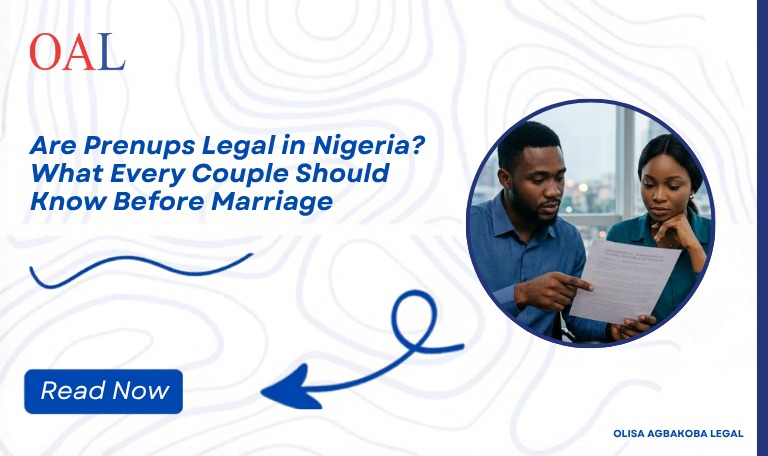
Picture a couple who spent twelve years building a successful business together. Then the marriage ends, and suddenly they are in court, each claiming the company as their own. The months drag on, legal fees quietly eat into the very assets they were fighting over, and the business they once built side by side begins to fall apart under the weight of the dispute. It is not how anyone pictures the end of a marriage, and it is exactly the kind of outcome a prenuptial agreement is designed to prevent. Which raises the question more Nigerian couples are starting to ask: are prenups legal in Nigeria, and would one actually hold up in court? The answer is more nuanced than a simple yes or no – and understanding how prenuptial agreements work under Nigerian law could save you years of conflict and a great deal of money.
In Nigeria, even mentioning a prenup can feel like an accusation. Simply raising it with your partner can feel, to them, like you are handing over divorce papers before the wedding has even happened. Family members may silently wonder what secrets you are hiding. As a result, many couples shy away from the topic, sign nothing, and trust that love alone will keep them together. And then circumstances change, as they sometimes do
Are Prenups Legal in Nigeria?
The short answer is yes, they are not illegal, but their enforceability is not guaranteed. There is no specific Nigerian law that outlines the precise process for drafting a prenuptial agreement or mandates how a court must enforce it. The relevant provision is found in Section 72(2) of the Matrimonial Causes Act 1970, which gives courts the authority to issue orders that are “just and equitable” regarding property within an ante-nuptial or post-nuptial settlement.
It is crucial to understand that while the law acknowledges the existence of these agreements, it does not guarantee their enforcement as written. Ultimately, the judge has the final say. That phrase — ‘just and equitable’ — is where everything is decided.
One important detail most people overlook is that Section 72(2) only applies to statutory marriages, which are those registered under the Marriage Act. Customary or Islamic-law marriages do not fall under this provision. Many Nigerian couples may go through both traditional rites and a “white wedding,” but it is vital to note that a prenup only pertains to the statutory aspect. This distinction is crucial before assuming that you have legal protection.
What a Prenup Can and Cannot Cover Under Nigerian Law
A prenuptial agreement can address various aspects of property and financial matters:
- Who retains ownership of the flat purchased before marriage?
- How do you divide a jointly built business?
- What happens to inheritances?
- How can you protect one spouse from being burdened by the other’s debts?
A prenup can provide clarity for estate planning, particularly in cases involving second marriages or children from previous relationships. However, what a prenup cannot determine is the future of your children. Matters like custody, maintenance, and the welfare of a child are governed by Section 70 of the same Act, prioritising the child’s best interest above any private agreements made by the parents. You cannot contractually relinquish these concerns, and no court will allow you to negate them.
Is a Prenup Enforceable in Nigeria? What the Courts Consider
Currently, there are no reported Nigerian cases that have successfully contested a prenup in court to provide clear guidance on how these agreements will be treated. The legal framework remains largely untested, relying more on principles than established precedents.
For context, let us look at a case outside Nigeria. In Radmacher v Granatino [2010] UKSC 42, a German heiress worth approximately £100 million married a French banker in London. Just three months before the wedding, they signed a prenup in Germany stipulating that neither would claim financial support from the other if the marriage ended. After the marriage did end, the husband, having left a high-paying banking job for a lower-paying research position, sought a share of her wealth. The UK Supreme Court upheld the prenup, emphasising the importance of fairness and informed consent in the agreement’s creation.
This reasoning mirrors the instinct a Nigerian judge would likely adopt: Was the agreement fair? Did both parties understand its terms? Was there any coercion involved?
A prenuptial agreement is not a sign of distrust in your marriage. It is closer to insuring a house you fully intend to live in for years to come.
How to Draft a Prenup That Holds Up in a Nigerian Court
In Nigeria, the strength of a prenuptial agreement hinges significantly on how it is crafted. A template hastily downloaded from the internet, signed in a rush just before the wedding without full financial disclosure or independent legal advice, is unlikely to stand up in court. Conversely, an agreement that is carefully constructed – with full disclosure, equitable terms, and independent legal counsel for each party – is much more likely to be upheld.
At OAL, we specialise in helping couples, families, and business owners draft prenups that stand the best chance of being enforced. Our agreements are clear, fair, and tailored to your unique assets, avoiding generic templates. We also offer postnuptial agreements for those who are already married but seek similar assurances, and we provide guidance on separating business interests when personal and professional lives intertwine.
Speak to OAL before the vows, not after the disagreements. An open, honest conversation now can help you avoid a lengthy and costly dispute later. Contact our team today.
Disclaimer: This article is intended for general informational purposes only and does not constitute legal advice for any specific situation. For personalized guidance, please consult a legal professional.investors, and regulators can see and trust.